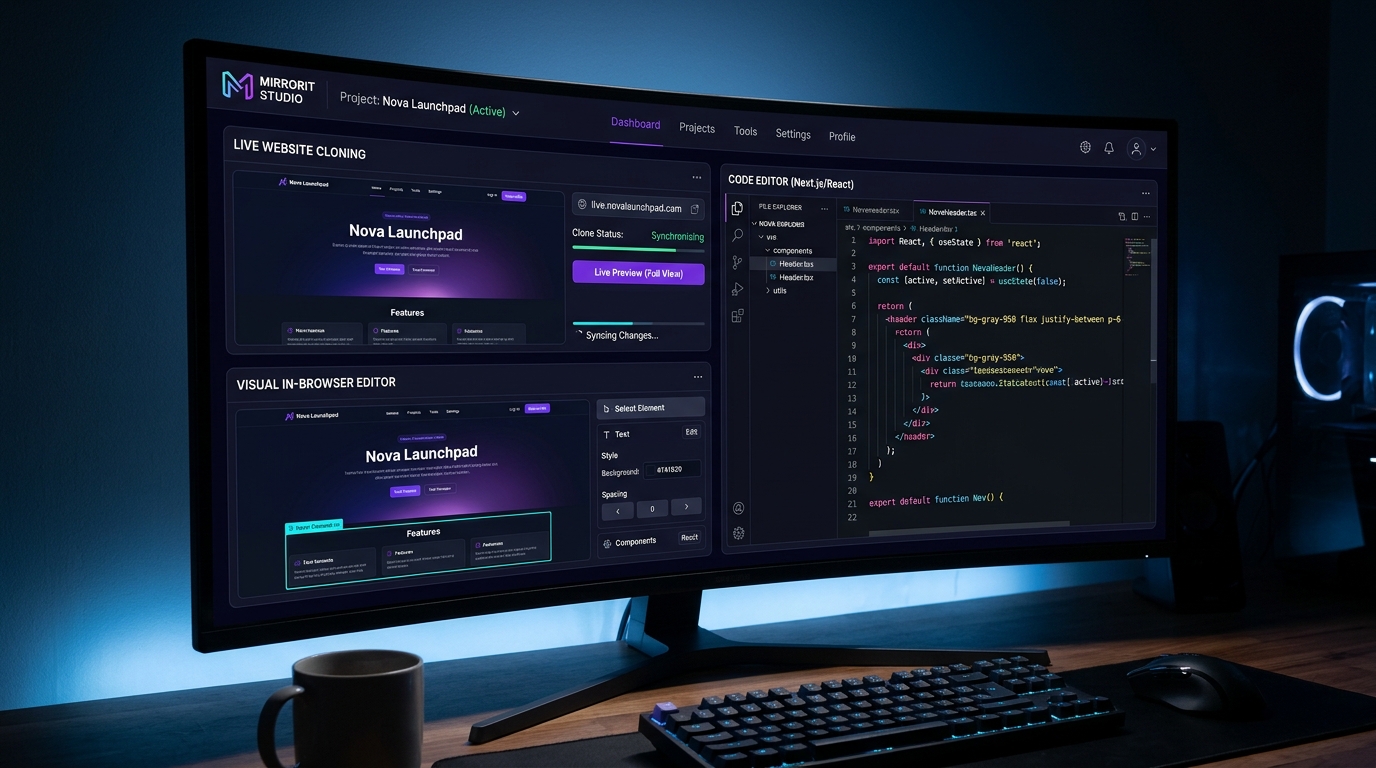
In modern web development, reverse-engineering, archiving, and migrating production web applications have historically been frustrating, error-prone tasks. Engineering teams and digital agencies frequently encounter fragile scrapers that collapse when facing modern Single-Page Applications (SPAs), broken dynamic asset paths (such as /_next/image), missing stylesheets, and disconnected toolchains. Transforming an existing website into a modern, production-grade frontend typically requires days of manual HTML extraction, CSS untangling, and component re-architecting.
Mirrorit Studio (mirrorit_app) eliminates this friction by unifying web cloning, in-browser visual editing, automated SEO remediation, design system extraction, and modern framework compilation into a single, cohesive developer workspace. Rather than acting as a simple scraper, Mirrorit operates as a complete web reverse-engineering and visual engineering ecosystem.
This comprehensive guide details the complete feature catalog of Mirrorit Studio, diving into the underlying engineering mechanisms, architectural workflows, and real-world case studies for each capability.
Table of Contents
- 1. Product Overview & Core Capabilities
- 2. The End-to-End User Workflow
- 3. Complete Feature Catalog & Real-World Case Studies
- 3.1 Zero-404 Cloning Engine & Deep Crawling
- 3.2 Live Preview & Sandbox Isolation
- 3.3 In-Browser Visual Website Builder
- 3.4 Enterprise Dual-Layer AI: Magic Wand & Agentic Assistant
- 3.5 Deterministic Modern Framework Exporter (Next.js 16 & Vue 3)
- 3.6 SEO Studio & Deterministic Quick-Fix Remediation
- 3.7 Design System & Token Extraction
- 3.8 Figma Bridge (HTML to Auto Layout)
- 3.9 Instant Zero-Config Go Live (Public Subdomains)
- 3.10 Peer-to-Peer Template & Component Marketplace
- 3.11 Project Management, Templates & Archive Imports
- 3.12 Clone Report & Operational Action Center
- 3.13 Transactional Safety: Two-Phase Commit Backups
- 3.14 Enterprise Admin Panel & Model Agnostic AI Gateway
- 4. Feature Gating & Subscription Tier Matrix
- 5. Conclusion & Enterprise Takeaways
1. Product Overview & Core Capabilities
At its core, Mirrorit Studio provides a robust, developer-first platform designed to solve ten fundamental frontend challenges:
- High-Fidelity Cloning: Replicates complex multi-page sites and JavaScript-heavy SPAs into structured local workspaces with zero broken assets (zero 404 guarantee).
- Code Reconstruction: Discovers and maps production source maps back to readable developer source trees (
_src/). - In-Browser Visual Builder: Provides direct DOM manipulation, style editing, and component layout adjustment within the browser viewport.
- Controlled AI Enhancement: Executes targeted component modifications and agentic edits through an enterprise-governed AI gateway without exposing model identities or raw prompts to end users.
- Zero-AI Deterministic Framework Compilation: Compiles raw cloned static assets into idiomatic, build-ready Next.js 16 (App Router) and Vue 3 (SFC + Vite) projects using AST heuristics.
- Automated SEO Auditing & Remediation: Runs asynchronous on-page technical SEO scans with real-time SSE progress and one-click deterministic fixes.
- Design System & Token Reverse Engineering: Extracts color palettes, fluid typography, spacing scales, CSS custom properties, and Tailwind configurations.
- Figma Auto Layout Bridge: Exports rendered DOM nodes and component hierarchies directly into native Figma layers with full Auto Layout properties.
- Instant Zero-Config Deployment: Publishes active workspaces to public HTTPS subdomains (
*.mirrorit.space) in seconds via atomic directory swaps. - Creator Marketplace: Enables designers and developers to buy, sell, and monetize custom templates and UI components with integrated Midtrans payments.
2. The End-to-End User Workflow
Mirrorit Studio connects previously siloed developer activities into a continuous, deterministic pipeline:
Target URL
    │
    ▼
[High-Speed Go Engine] ──(Chromium DOM Telemetry)──► Local Zero-404 Workspace
    │
    ▼
[Live Preview Sandbox] ◄──► [In-Browser Visual Builder] ◄──► [Magic Wand AI]
    │
    ├─► [SEO Studio] ──► Deterministic Quick-Fix Remediation
    │
    ├─► [Design System Extractor] ──► Tailwind Config / CSS Tokens / Figma Bridge
    │
    ├─► [Zero-AI Framework Exporter] ──► Production Next.js 16 / Vue 3 Repository
    │
    └─► [Instant Go Live] ──► Public Subdomain (https://*.mirrorit.space) / Marketplace
3. Complete Feature Catalog & Real-World Case Studies
3.1 Zero-404 Cloning Engine & Deep Crawling
Traditional web scrapers treat web pages as flat text documents. They break when encountering client-side route transitions, dynamically injected stylesheets, or CDN-optimized image URLs. Mirrorit’s engine employs a dual-tier approach:
- High-Throughput Go Core (
cloner-go): Precompiled native binaries (x86_64 and ARM64) handle high-concurrency HTTP fetching, connection reuse, stream decompression, and recursive path rewriting. - Deep Next.js Asset Interception: Detects and preserves Next.js image optimization routes (
/_next/image), follows device-pixel-ratio (DPR) queries, maps dynamic static chunks (/_next/static/), and cleanly isolates React Server Component (RSC) payload boundaries. - SPA Dynamic Asset Scanner: When targets run on dynamic bundlers (Vite, Webpack, Turbopack), a headless Chromium session renders the DOM while a static AST parser inspects JavaScript bundles for dynamically loaded asset strings and fonts (
.woff2,.ttf). - Pure Python Code Beautifier: Formats HTML, CSS, and JavaScript with consistent 2-space indentation without requiring heavy external Node.js dependencies.
Real-World Case Study:
A digital agency needs to archive a client’s high-traffic marketing landing page built on Next.js with over 75 dynamically sized/_next/imageassets and client-side tab navigation. Using Mirrorit, the team pastes the target URL. The engine crawls the internal domain, decodes the image manifests, rewrites CSS background images, and stores all assets into an organizedcloned_domain/folder. The workspace launches offline with zero missing assets and zero console 404 errors.
3.2 Live Preview & Sandbox Isolation
Mirrorit provides instant visual feedback without requiring external web servers or manual staging deployments:
- Dual-Mode Preview: Workspaces can be previewed either via integrated proxy routes (
/_sites/<folder>/...) or by spawning on-demand micro-servers on dynamic local ports. - On-the-Fly Asset Cache: Any runtime asset requests triggered during preview sessions are cached dynamically, ensuring the preview environment remains completely insulated from network outages or upstream CDN changes.
- Shareable Preview Links: Pro and Max users can generate authenticated preview links accessible across local networks or team environments to demonstrate live progress to stakeholders before publishing.
Real-World Case Study:
A freelance developer redesigning a client’s storefront activates an on-demand micro-server with one click. Mirrorit serves the project athttp://192.168.1.105:4123. The developer shares the link with the client across the local testing network, allowing the client to verify live responsiveness directly on physical mobile devices.
3.3 In-Browser Visual Website Builder
Mirrorit Studio includes a native, in-browser visual WYSIWYG editor that allows users to modify live HTML elements directly within the preview viewport without touching source code manually:
- Atomic Element Operations: Select, reorder, duplicate, remove, and insert new structural components (from the Add Elements drawer) with exact DOM positioning.
- Visual Style & Effect Panels: Modify typography, padding, margins, borders, shadows, and flexbox/grid alignments visually.
- Global Color Replacement: Identify any hex or RGB color value across the entire project and perform project-wide replacements in a single atomic operation (e.g., swapping
#ff8c00to brand red#e0222dacross all stylesheets and inline rules). - DOM Layers Outliner & Schema Sync: Navigate complex page hierarchies through an interactive tree view, synchronized with backend schema definitions.
Real-World Case Study:
A non-technical product manager needs to rebrand a cloned conference website. By clicking elements directly in the visual builder, the manager updates speaker bios, changes hero button gradients, and triggers a global color replacement that updates 14 distinct CSS files instantaneously—all secured by automatic transactional backups.
3.4 Enterprise Dual-Layer AI: Magic Wand & Agentic Assistant
Mirrorit incorporates a governed, two-tier AI architecture managed through an enterprise AI Gateway:
- Admin-Controlled AI Gateway: All Large Language Model (LLM) communications route through
server/ai_gateway.py. Model selections, fallback chains, retry logic for HTTP 429 rate limits, and provider API keys are strictly configured by system administrators. End users never see model metadata or prompt templates. - AI Magic Wand (Contextual Element Mutation): Users highlight any specific DOM node in the visual builder and provide a targeted natural-language prompt (e.g., “Restyle this pricing card with a dark glassmorphic card design and higher CTA contrast”). The gateway generates clean, replacement HTML/CSS, strips internal attributes, and updates the file system within a transactional snapshot.
- Agentic Chat Assistant (Multi-Step Tool Execution): For broader refactoring tasks, the integrated chat assistant leverages an autonomous tool-calling loop (
read_file,list_files,replace_in_file,insert_at_line,search_in_files) with real-time SSE progress streaming via/api/edit-stream.
Real-World Case Study:
A developer needs to convert a multi-column desktop navbar into a fully responsive mobile drawer navigation. Instead of manually writing CSS media queries, they instruct the Agentic Assistant: “Make this navigation collapse into a hamburger menu below 768px with smooth slide-in animation.” The agent inspects the stylesheet, writes responsive classes, injects the necessary toggle JavaScript, and reports each step over the SSE event stream.
3.5 Deterministic Modern Framework Exporter (Next.js 16 & Vue 3)
One of Mirrorit Studio’s most powerful capabilities is its Zero-AI Deterministic Compiler (server/framework_exporter/). Rather than relying on unpredictable LLM code generation, the exporter uses strict Abstract Syntax Tree (AST) analysis and intermediate representation (IR v2) models to compile raw cloned code into production-ready repositories:
| Pipeline Stage | Module | Technical Responsibility |
|---|---|---|
| 1. Bundle Audit | SourceAuditor |
Evaluates source map coverage and identifies bundle entry points. |
| 2. Unpacking | BundleUnpacker |
Extracts original module boundaries and reconstructs asset linkages. |
| 3. DOM Normalization | DOMNormalizer + CSSPreserver |
Purges framework runtime artifacts while retaining computed styling rules. |
| 4. Pattern Detection | RepeaterDetector |
Detects repeated layout structures (e.g., pricing cards, feature grids) and extracts structured props. |
| 5. Interaction Analysis | InteractionAnalyzer |
Identifies form bindings, click handlers, and navigation links. |
| 6. IR Construction | IRBuilder |
Constructs an Intermediate Representation tree with strict provenance tracking. |
| 7. Code Generation | NextJSGenerator / VueGenerator |
Synthesizes idiomatic Next.js 16 App Router (src/app/page.tsx) or Vue 3 SFC (.vue) files. |
| 8. Code Formatting | CodeFormatter |
Executes Prettier formatting for clean, lint-compliant codebases. |
| 9. Sandboxed Verification | VerificationGate |
Executes an isolated npm run build check to guarantee build success before outputting the final ZIP. |
The compiler also features an optional AI Naming Companion. When enabled, a single constrained LLM call evaluates component structures and suggests semantic PascalCase names (e.g., renaming a generic RepeaterSection3 to PricingTierGrid). If the model fails or returns invalid identifiers, the compiler deterministically falls back to structural names without halting the export pipeline.
Real-World Case Study:
An engineering team migrating a legacy static marketing site to Next.js 16 executes the Framework Exporter. The engine automatically identifies three repeated pricing columns, createsPricingCard.tsxwith typed props (title,price,features), wires them into an array mapping insidesrc/app/page.tsx, validates the build in a sandbox, and packages a ready-to-deploy Next.js project.
3.6 SEO Studio & Deterministic Quick-Fix Remediation
Mirrorit’s integrated SEO Studio runs comprehensive technical on-page audits and provides automated, zero-guesswork fixes:
- Asynchronous Scan Engine: Audits meta titles, descriptions, Open Graph protocol tags (
og:image,og:title), viewport declarations, language attributes, and canonical URLs with live progress streamed over SSE. - Heading Structure Validation: Identifies heading skips (e.g., jumping from
<h1>directly to<h3>) to preserve accessibility standards. - Image Optimization Checks: Scans for missing or empty
altattributes. - One-Click Quick Fixes: Automatically generates compliant meta descriptions derived deterministically from existing H1 and introductory body paragraphs, injects missing canonical tags, and corrects markup errors directly on disk with snapshot rollback support.
Real-World Case Study:
A website audit reveals 18 missing image alt tags and an absent meta description. With SEO Studio, the user clicks “Quick Fix All”. The system analyzes parent figure containers to generate descriptive alt text, constructs an optimal 145-character meta description from the primary heading, and commits the fixes to HTML in seconds.
3.7 Design System & Token Extraction
Modern frontend workflows demand reusable design tokens. Mirrorit extracts visual properties from cloned websites into structured, portable design systems:
- Palette & Typography Extraction: Analyzes computed DOM styles to extract primary, secondary, and accent color swatches, font families, and weights.
- Multi-Format Token Export: Generates CSS custom properties (
:root { --color-primary: ...; }), ready-to-usetailwind.config.jstheme extensions, and standard design token JSON files. - Full Style Dictionary (Max Tier): Outputs comprehensive token dictionaries covering border radii, elevation shadows, and fluid spacing scales.
3.8 Figma Bridge (HTML to Auto Layout)
Bridging the gap between code and design, Mirrorit’s Figma Bridge transforms live web markup into editable Figma components:
- Figma Plugin Integration: Downloadable plugin companion communicates with Mirrorit’s schema endpoint (
/api/figma/latest-schema). - Native Auto Layout Hierarchy: Rather than pasting flat vectors or screenshots, the bridge reconstructs nested Auto Layout frames, flex directions, padding tokens, typography styles, and corner radii directly into the Figma canvas.
Real-World Case Study:
A UI/UX designer tasked with redesigning a competitor’s complex checkout flow uses the Figma Bridge. With one click, the multi-step checkout form is translated into fully editable Figma frames with native Auto Layout, allowing the designer to begin rapid prototyping immediately.
3.9 Instant Zero-Config Go Live (Public Subdomains)
Mirrorit enables instant public deployment without third-party hosting setup or manual DNS configuration:
- Instant Subdomain Provisioning: Deploys workspaces to human-readable subdomains (e.g.,
https://silver-meadow-fox.mirrorit.space) utilizing wildcard DNS and automated Let’s Encrypt SSL certificates. - Atomic Swap Architecture: Deployments copy validated assets to an isolated sandbox storage directory (
live_sites/) using atomic symlink/directory swaps. This guarantees zero downtime and isolates the public site from ongoing local edits. - Custom Domain Support: Max tier subscribers can bind custom apex domains or subdomains with automatic SSL provisioning.
3.10 Peer-to-Peer Template & Component Marketplace
Mirrorit fosters an internal creator economy where developers can monetize their reverse-engineering and visual customization work:
- Packaging & Publishing: Users can package modified workspaces as complete website templates or export isolated UI components (e.g., interactive navigation bars, hero layouts) directly to the marketplace.
- Payment Integration: Features integrated Midtrans payment processing for seamless checkout via credit cards, bank transfers, and QRIS.
- Instant Workspace Import: Buyers can preview items in real time and install purchased templates directly into their Mirrorit workspace with a single click.
3.11 Project Management, Templates & Archive Imports
- ZIP Archive Import: Upload legacy static website archives (HTML, CSS, JS bundles) via drag-and-drop to immediately initialize a Mirrorit project workspace.
- Curated Starter Templates: Choose from built-in starter templates across e-commerce, SaaS landing pages, portfolios, and blogs.
- Workspace Operations: Full lifecycle support for renaming, duplicating, resetting, and organizing cloned workspaces.
3.12 Clone Report & Operational Action Center
Every cloned project generates a comprehensive Clone Report that serves as the mission control center:
- Asset Coverage Telemetry: Quantifies cloning success rates (e.g., 98.5% assets resolved, 0 broken paths).
- Unified Health Metrics: Displays SEO scores, total bundle weight, asset distribution graphs, and responsive layout checks.
- One-Click Action Triggers: Quick action buttons to launch live previews, run framework exports, trigger SEO quick fixes, or publish to Go Live.
3.13 Transactional Safety: Two-Phase Commit Backups
File corruption during automated code editing can cripple a project. Mirrorit implements a strict Two-Phase Commit Snapshot System (server/backups.py):
- Prior to any file mutation (via Visual Builder, Magic Wand, or SEO Quick Fix), a pending snapshot is stored in
_backups/. - If the write operation or parsing succeeds, the snapshot is committed into the version history.
- If an error occurs or a network stream disconnects, the pending backup is cleanly discarded and the working copy remains completely uncorrupted.
- Full multi-level Undo/Redo capabilities are available directly from the Studio toolbar.
3.14 Enterprise Admin Panel & Model Agnostic AI Gateway
Mirrorit includes an isolated, high-security administration panel (mirrorit_admin) built on Next.js:
- User & Subscription Governance: Manage user quotas, suspend or activate accounts, modify subscription tiers, and audit platform usage.
- AI Gateway Configuration: Configure LLM base URLs (e.g., 9router), API keys (masked in all GET requests), primary models, and fallback chains without server restarts.
- Marketplace Moderation: Inspect seller listings, approve templates, resolve copyright flags, and manage creator payout balances.
- Audit Logs: Comprehensive tracking of administrative actions for enterprise compliance.
4. Feature Gating & Subscription Tier Matrix
Mirrorit enforces feature capabilities at runtime according to active subscription tiers. Below is the official capability matrix governed by subscription_service.py:
| Feature Capability | Free Tier (Rp0) | Pro Tier (Rp35.000 / mo) | Max Tier (Rp69.000 / mo) |
|---|---|---|---|
| Active Websites | 2 sites | 5 sites | Unlimited |
| Workspace Storage | 500 MB | 1 GB | 3 GB |
| Interactive Visual Builder | Included | Included | Included |
| On-Page SEO Auditing | Included | Included | Included |
| Source Map Reverse Engineering | Included | Included | Included |
| ZIP Download | Preview only (Studio) | Included (Clean) | Included (Clean) |
| Watermark / Branding | Watermark present | Removed | Removed |
| Design Token Depth | Palette & Fonts | + CSS Vars, Tailwind, JSON | Full Style Dictionary |
| Shareable Preview Link | Unavailable | Included | Included |
| Multi-Page Deep Crawling | Unavailable | Unavailable | Included |
| Modern Framework Exporter (Next.js / Vue) | Unavailable | Unavailable | Included (Full Access) |
| Advanced Core Web Vitals & Asset Minifier | Unavailable | Unavailable | Included |
| Figma Auto Layout Bridge | Unavailable | Unavailable | Included (Unlimited) |
| Instant Go Live (Public Subdomain) | Unavailable | Unavailable | Included |
| Custom Domain Binding | Unavailable | Unavailable | Included |
| Priority Processing & Dedicated Worker | Standard Queue | Priority Queue | Dedicated Worker |
| AI Magic Wand & Agentic Assistant | Runtime enabled* | Runtime enabled* | Runtime enabled* |
*Note: AI features are dynamically available across all tiers when the administrator has configured the central AI Gateway in the Admin Panel.
5. Conclusion & Enterprise Takeaways
Mirrorit Studio represents a major evolution in how software engineers, designers, and agencies interact with the live web. By replacing brittle text-scraping hacks with a deterministic compiler pipeline, high-throughput Go networking, transactional visual editing, and enterprise AI orchestration, Mirrorit establishes a repeatable, production-grade standard for web cloning and modernization.
Whether you are preserving critical digital heritage, accelerating frontend redesigns in Figma, modernizing legacy web properties into Next.js 16, or publishing turnkey prototypes in seconds, Mirrorit Studio provides the unified tooling required to bridge the gap between inspiration and production-ready code.
Leave a Reply