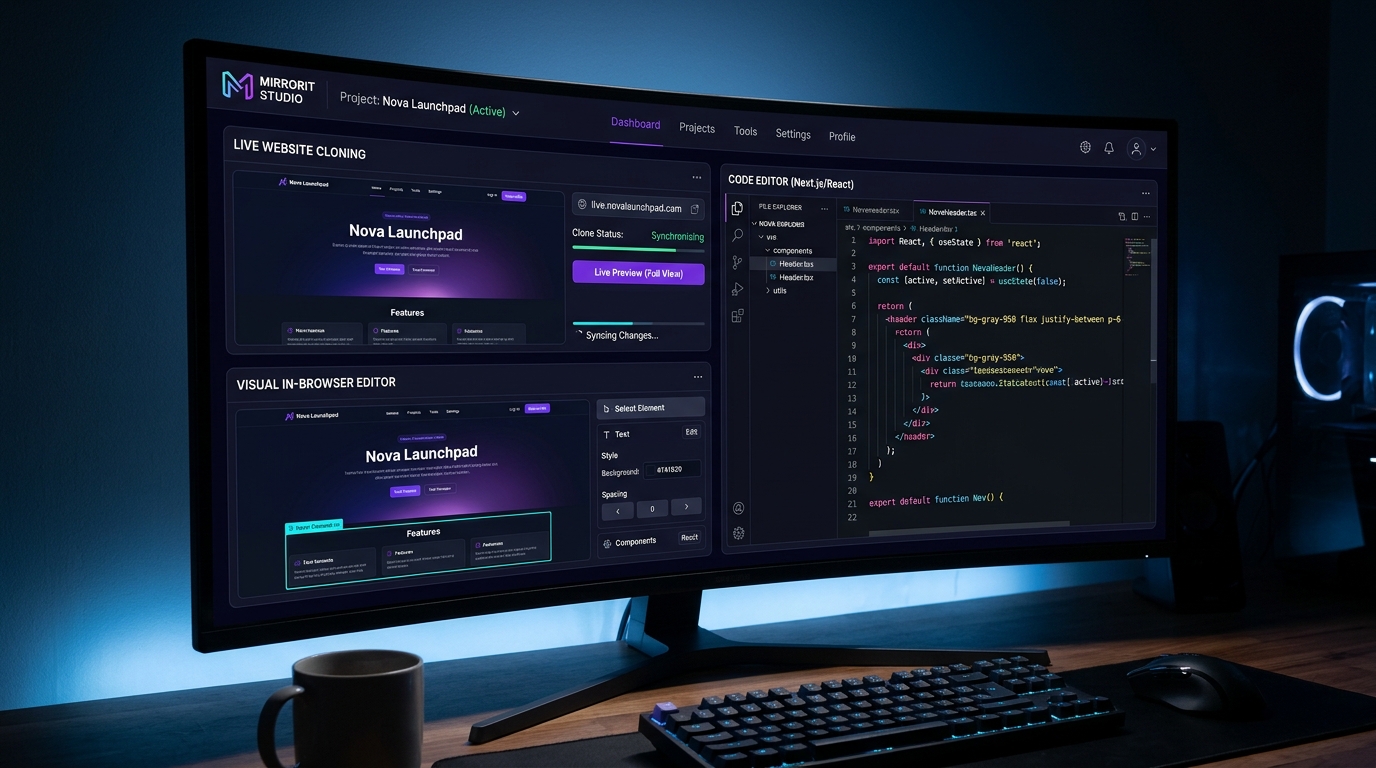
In modern web engineering, web reverse-engineering and site archiving have traditionally been fragmented, fragile disciplines. Developers tasked with migrating legacy client applications, creating design mockups from existing production sites, or auditing live frontends typically rely on disconnected tools: command-line scrapers that break on dynamic single-page applications (SPAs), browser screenshot extensions that capture pixels without code semantics, and error-prone copy-paste workflows.
When dealing with contemporary frameworks like Next.js (App Router / React Server Components), Vue 3, and dynamic bundlers (Vite, Webpack), standard scrapers routinely fail. They leave behind broken image routes (/_next/image), severed JavaScript chunk manifests, isolated CSS module classes, and hundreds of 404 Not Found console errors.
Mirrorit Studio was engineered to fundamentally resolve this friction. Rather than treating site duplication as simple HTTP scraping, Mirrorit treats web cloning as a holistic software reverse-engineering pipeline. By uniting a high-throughput Go cloning engine, headless Chromium DOM interception, a transactional in-browser visual builder, an agentic AI assistant, and a deterministic Zero-AI AST framework compiler, Mirrorit bridges the chasm between raw web discovery and production-ready frontend codebases.
Table of Contents
- 1. High-Level Architecture & Unified Workflow
- 2. The Cloning Engine: Achieving Zero-404 Resiliency in Modern SPAs
- 3. In-Browser Visual Website Builder with Transactional Snapshots
- 4. Dual-Layer AI Architecture: Magic Wand & Agentic Chat Assistant
- 5. Deterministic Framework Exporter: Compiling to Next.js 16 & Vue 3
- 6. Design Token Reverse-Engineering & Figma Auto Layout Bridge
- 7. SEO Studio & Deterministic Quick-Fix Remediation
- 8. Instant Zero-Config Go Live & Peer-to-Peer Marketplace
- 9. Conclusion & Enterprise Implications
1. High-Level Architecture & Unified Workflow
At its core, Mirrorit Studio is organized around a dual-engine architectural pattern designed for high computational throughput, runtime security, and real-time developer feedback:
| Layer | Technologies / Modules | Architectural Responsibility |
|---|---|---|
| Core Application Server | Python HTTP runtime, PostgreSQL / SQLite, 21 Domain Route Groups | State management, RBAC authorization, transactional file snapshots, and subscription enforcement. |
| High-Speed Engine | Go 1.21+ (cloner-go native binaries) |
Parallel HTTP asset fetching, stream decompression, and recursive path normalization. |
| DOM Telemetry | Headless Chromium / Chrome DevTools Protocol | SPA hydration capture, dynamic JavaScript asset execution, and computed style extraction. |
| Studio Frontend | Modular Vanilla JS, Tailwind CSS v4, Arc Semantic Tokens | Zero-overhead in-browser workspace, DOM Layers outliner, and style mutation panels. |
| Realtime Transport | Server-Sent Events (SSE) (/api/stream, /api/edit-stream, /api/seo/stream) |
Sub-millisecond telemetry, task progress tracking, and agentic tool-execution logging. |
| AI Orchestration | Admin AI Gateway, Fallback Chains, Rule-Based Intent Classifier | Unified LLM abstraction layer with zero model exposure to end-user clients. |
The developer journey follows an intuitive, end-to-end lifecycle:
Target URL → Deep Go Crawler → Local Zero-404 Workspace → Live Preview Sandbox
     ↓
Visual Builder / Magic Wand AI → Automated SEO Audit → Deterministic Framework Compiler
     ↓
Production Next.js 16 App / Vue 3 Project → 1-Click Go Live (Subdomain) → Marketplace
2. The Cloning Engine: Achieving Zero-404 Resiliency in Modern SPAs
The primary point of failure for legacy cloning tools is the assumption that a website is a static bundle of interconnected HTML pages. In today’s web ecosystem, web assets are lazily loaded, dynamically imported via Webpack/Vite chunks, rendered through React Server Components, or injected as computed inline CSS styles.
Mirrorit’s cloning engine implements a multi-tier asset resolution pipeline to achieve 100% asset coverage:
A. Next.js & Dynamic Image Pipeline Interception
Next.js applications frequently leverage the /_next/image optimization endpoint, which proxies source images through cryptographic hashes and custom quality query parameters (/_next/image?url=...&w=1920&q=75). Standard scrapers either download the low-res placeholder or fail when encountering CDN access restrictions. Mirrorit intercepts dynamic image loader manifests, follows full device-pixel-ratio (DPR) variations, isolates /_next/static/ chunks, and mirrors images into clean local directories without path breakage.
B. SPA Deep Asset Scanner & Dynamic Bundle Analysis
When target applications rely heavily on client-side routing (Vite, React Router, Nuxt), Mirrorit spawns a headless Chromium instance to allow the JavaScript execution thread to settle. Simultaneously, a static AST scanner parses JavaScript chunk bundles (*.js) to discover asset strings, SVG icons, and dynamic import() boundaries that might only trigger under specific user interactions.
C. Recursive CSS & Typography Resolvers
Nested CSS stylesheets often reference web fonts (.woff2, .woff, .ttf) and background imagery through relative or root-relative paths. Mirrorit’s pure-Python beautifier and Go resolver parse all @font-face and url() declarations, download the referenced binary files, rewrite CSS declaration paths to internal local relative routes, and format stylesheets with consistent 2-space indentation—all without requiring external Node.js dependencies.
3. In-Browser Visual Website Builder with Transactional Snapshots
Once a site is cloned into a workspace (e.g., cloned_example_com/), developers and designers are not limited to inspecting raw code. Mirrorit Studio mounts an in-browser visual WYSIWYG editor directly on top of the live mirrored document.
Atomic Element Operations
Through the builder interface, users can select any DOM node to perform instant structural manipulations:
- Element Hierarchy: Reorder, duplicate, insert, or delete nodes via an interactive DOM Layers tree.
- Inline Style Management: Fine-tune typography, margins, paddings, flexbox alignments, and drop shadows via semantic property panels.
- Global Color Swapping: The
replace-global-colorroutine traverses every CSS rule across the entire project, updating brand color hex codes (e.g.,#ff8c00 → #0ea5e9) uniformly across all linked stylesheets in a single operation. - Asset Replacement: Modal image uploaders with automated path updates and thumbnail previews.
Transactional Safety & Instant Rollbacks
Directly modifying production-grade source code inside a browser can easily lead to syntax corruption if a browser crash or network drop occurs. To prevent corrupted states, Mirrorit enforces a transactional snapshot architecture (server/backups.py):
The Transaction Guarantee: Every mutation initiated in the Builder or AI assistant triggers
create_site_backup_pendingbefore disk I/O occurs. If the mutation succeeds and passes schema validation, the operation is committed. If any step fails or violates path security guards, the pending backup is discarded and the working copy remains pristine.
4. Dual-Layer AI Architecture: Magic Wand & Agentic Chat Assistant
Mirrorit introduces a governed, privacy-conscious AI subsystem designed specifically for frontend code modification:
A. Enterprise-Governed AI Gateway
Unlike consumer AI tools that require users to provide individual API keys or select LLM model names directly in the frontend, Mirrorit centralizes all inference behind an administrative AI Gateway (server/ai_gateway.py). Administrators configure the primary provider, fallback chains, and rate-limiting protocols via the Admin Panel. End users interact with clean, model-agnostic endpoints; parameter tampering is rejected at the API boundary.
B. AI Magic Wand (Contextual In-Place Mutations)
When editing a landing page, a user can highlight a specific visual element—such as a pricing card or testimonial carousel—and invoke the Magic Wand (POST /api/builder/ai-edit-element) with natural language: “Make this pricing card look like a high-contrast enterprise tier with a gradient border.”
The server captures the element’s inner and outer HTML, dispatches it with visual context to the AI Gateway, strips dangerous scripts and internal attributes, writes the sanitized replacement directly to the source file, and updates the live preview canvas without page reloads.
C. Agentic Chat Assistant & SSE Tool-Calling Loop
For cross-file operations, Mirrorit provides an Agentic Chat Assistant. User prompts undergo rule-based intent classification to distinguish general conversation from actionable code edits. When an edit command is detected, the agent utilizes a dedicated tool execution loop:
# Supported Agent Tool Definitions
tools = [
    "read_file",        # Read file contents within site_dir sandbox
    "list_files",       # Inspect project directory structure
    "replace_in_file",  # Precision regex and substring replacement
    "write_file",       # Write new templates or components
    "insert_at_line",   # Inject styles or scripts at specific offsets
    "delete_lines",     # Clean up legacy scripts or trackers
    "search_in_files",  # Global codebase pattern search
    "get_site_info"     # Retrieve metadata and asset inventory
]
Every step of the agent’s reasoning, file reading, and code replacement streams back to the user via Server-Sent Events (/api/edit-stream), delivering full transparency and live auditability.
5. Deterministic Framework Exporter: Compiling to Next.js 16 & Vue 3
Perhaps the most technically demanding challenge in web cloning is converting static, captured HTML/CSS into a modular, maintainable modern JavaScript framework project. While many tools attempt to pass entire HTML files into an LLM and ask for React code, this approach suffers from severe nondeterminism: hallucinated dependencies, truncated files, invalid JSX syntax, and loss of responsive CSS.
Mirrorit solves this with a Deterministic Zero-AI AST Framework Compiler (server/framework_exporter/), augmented by an optional, non-destructive AI Naming Companion.
The Deterministic Compiler Pipeline
- SourceAuditor: Evaluates bundle coverage and inspects available source maps to recover original source paths from
_src/. - DOMNormalizer & CSSPreserver: Converts raw HTML into an XML-compliant DOM tree while scoping and encapsulating extracted styles into CSS Modules or Tailwind utility classes.
- RepeaterDetector: Algorithmically scans sibling DOM nodes for structural congruence. When it identifies repeating structures (such as pricing cards, feature grids, or blog post cards), it abstracts them into a parent container component (
<PricingSection />) and a typed child component (<PricingCard />), extracting unique strings and images into a structuredpropsarray. - Intermediate Representation (IR v2): Builds an abstract Intermediate Representation detailing module dependencies, component hierarchies, and isolated style bindings.
- Target Generators: Emits clean, idiomatic code for either Next.js 16 (App Router with TypeScript) or Vue 3 (Single File Components with Vite).
- Verification Gate: Executes a sandboxed build check (
npm run build) to guarantee that the generated codebase compiles cleanly before packing the final ZIP archive.
Optional AI Naming Companion
To ensure components have descriptive, semantic PascalCase names (e.g., HeroHeroicCTA.tsx rather than Section_3_Div_12.tsx), Mirrorit incorporates a isolated AI Naming Companion. The companion operates solely as a naming advisor: it receives extracted semantic clues (headings, button labels, class names) and suggests component names. These names are rigorously validated against strict naming contracts and injected via a complete IR Rebuild, ensuring imports, exports, and file systems remain 100% synchronized.
6. Design Token Reverse-Engineering & Figma Auto Layout Bridge
For design and UI/UX teams, extracting a cohesive design system from an existing production application is typically a manual ordeal. Mirrorit automates this workflow directly from computed browser telemetry:
Automated Design Token Extraction
Mirrorit traverses the DOM tree to catalog computed styles, clustering colors using the CIEDE2000 color-difference formula to identify primary, secondary, and neutral palettes. It analyzes line-heights, letter-spacing, and fluid typography clamps to formulate harmonic type scales, and derives responsive spacing rules. Output formats include:
- Standard W3C Design Tokens (JSON format)
- CSS Custom Properties (
:root { --color-primary: #6366f1; ... }) - Ready-to-use
tailwind.config.jstheme extensions
The HTML-to-Figma Bridge
Through the official Mirrorit Figma Plugin, users can export any section or full-page layout directly into Figma. The bridge parses CSS Flexbox and Grid layouts, translating DOM nodes into native Figma Auto Layout frames, vector shapes, and typography styles. This allows design teams to immediately begin prototyping redesigns in Figma without redrawing interfaces from scratch.
7. SEO Studio & Deterministic Quick-Fix Remediation
A website clone is rarely ready for production redeployment without an on-page technical SEO audit. Mirrorit integrates an on-demand SEO Studio that scans local pages and delivers real-time diagnostic reports via SSE:
- Meta & Social Graph Validation: Checks for missing or truncated
<title>,meta description, canonical links, and Open Graph cards (og:image,og:title). - Heading Hierarchy Auditing: Flags heading skips (e.g.,
<h1>followed directly by<h3>) to preserve document semantics. - Accessibility Compliance: Automatically flags
missing_altor empty image tags. - Core Web Vitals & Asset Compression: The Pro/Max tiers provide automated WebP image conversion and CSS/JS minification to guarantee high Lighthouse performance.
Crucially, SEO Studio includes One-Click Quick Fixes. Rather than forcing manual code edits, the engine automatically synthesizes missing meta descriptions from top-level headings and paragraphs, injects missing canonical tags, and writes the updates directly to the file system with snapshot backup protection.
8. Instant Zero-Config Go Live & Peer-to-Peer Marketplace
Mirrorit streamlines the transition from local experimentation to live public presentation:
Instant Zero-Config Deployment (Go Live)
With a single click on the Go Live button, Mirrorit deploys the active workspace to an isolated, public HTTPS subdomain (e.g., https://silver-meadow-fox.mirrorit.space). The underlying infrastructure leverages wildcard DNS, automatic Let’s Encrypt SSL certificates, and an Nginx reverse proxy. Deployments utilize an atomic directory swap mechanism: assets are validated and copied to an isolated sandbox (live_sites/), ensuring zero downtime and complete isolation from local workspace edits.
The Mirrorit Marketplace
Mirrorit fosters a creator-driven ecosystem through its built-in Marketplace. Developers and designers can package their cloned, customized, and polished templates or individual UI components (such as animated hero headers or responsive navigation bars) and publish them for sale. With integrated payment processing via Midtrans, creators can monetize their design engineering work, while buyers can instantly import purchased items into their own workspaces with one click.
9. Conclusion & Enterprise Implications
Mirrorit Studio marks a significant paradigm shift in how developers interact with the existing web. By moving past primitive text scrapers and brittle AI hallucination loops, Mirrorit establishes a robust, deterministic engineering platform that respects modern web architectures.
Whether employed for enterprise legacy migrations, rapid competitive prototyping, high-fidelity UI/UX archiving, or automated Next.js framework conversion, Mirrorit Studio bridges the gap between what is currently live on the web and the modern component-driven codebases engineering teams strive to build.
Leave a Reply