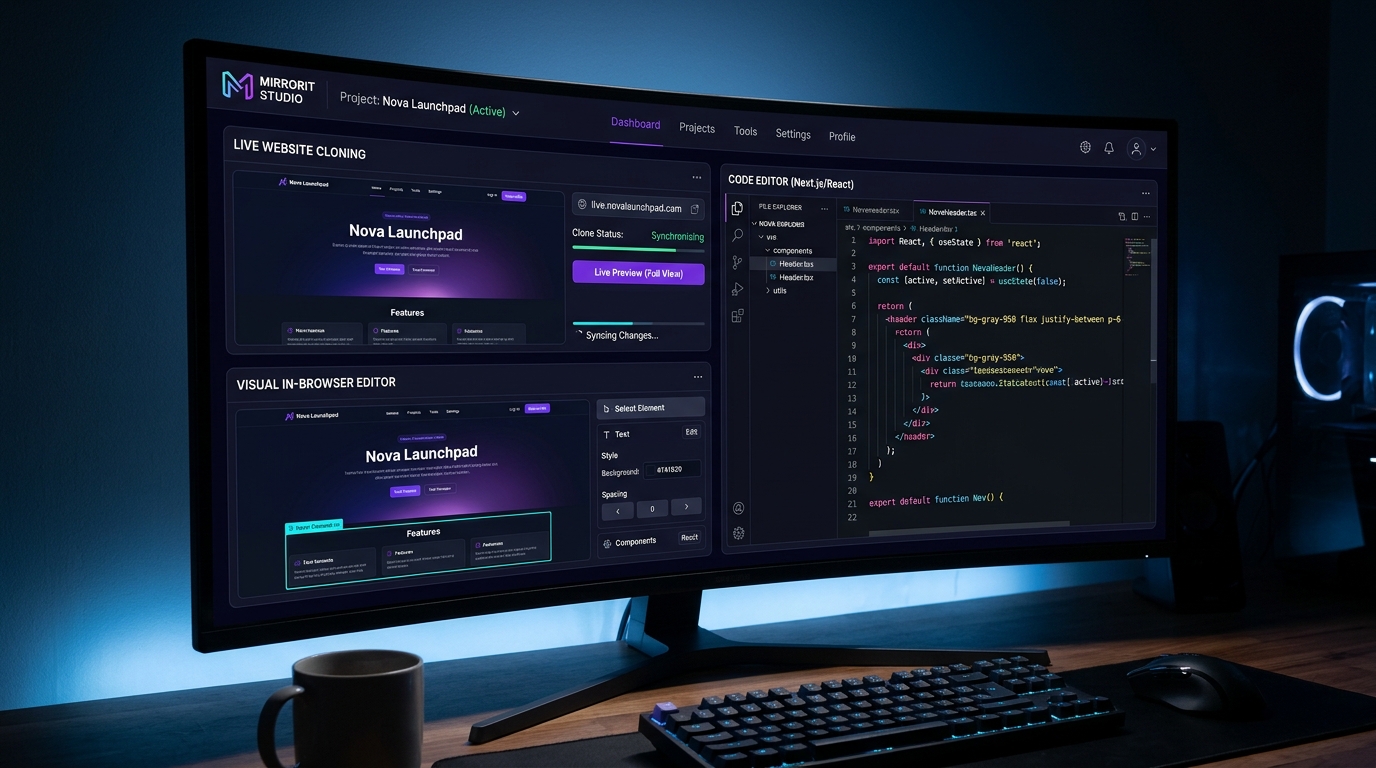
Category: Mirrorit

Articles, reverse engineering notes, and technical deep-dives for Mirrorit.

  • Mastering Mirrorit Studio: The Complete Feature Guide, Real-World Use Cases, and Workflow Architecture

    Mastering Mirrorit Studio: The Complete Feature Guide, Real-World Use Cases, and Workflow Architecture

    In modern web development, reverse-engineering, archiving, and migrating production web applications have historically been frustrating, error-prone tasks. Engineering teams and digital agencies frequently encounter fragile scrapers that collapse when facing modern Single-Page Applications (SPAs), broken dynamic asset paths (such as /_next/image), missing stylesheets, and disconnected toolchains. Transforming an existing website into a modern, production-grade frontend typically requires days of manual HTML extraction, CSS untangling, and component re-architecting.

    Mirrorit Studio (mirrorit_app) eliminates this friction by unifying web cloning, in-browser visual editing, automated SEO remediation, design system extraction, and modern framework compilation into a single, cohesive developer workspace. Rather than acting as a simple scraper, Mirrorit operates as a complete web reverse-engineering and visual engineering ecosystem.

    This comprehensive guide details the complete feature catalog of Mirrorit Studio, diving into the underlying engineering mechanisms, architectural workflows, and real-world case studies for each capability.


    Table of Contents


    1. Product Overview & Core Capabilities

    At its core, Mirrorit Studio provides a robust, developer-first platform designed to solve ten fundamental frontend challenges:

    1. High-Fidelity Cloning: Replicates complex multi-page sites and JavaScript-heavy SPAs into structured local workspaces with zero broken assets (zero 404 guarantee).
    2. Code Reconstruction: Discovers and maps production source maps back to readable developer source trees (_src/).
    3. In-Browser Visual Builder: Provides direct DOM manipulation, style editing, and component layout adjustment within the browser viewport.
    4. Controlled AI Enhancement: Executes targeted component modifications and agentic edits through an enterprise-governed AI gateway without exposing model identities or raw prompts to end users.
    5. Zero-AI Deterministic Framework Compilation: Compiles raw cloned static assets into idiomatic, build-ready Next.js 16 (App Router) and Vue 3 (SFC + Vite) projects using AST heuristics.
    6. Automated SEO Auditing & Remediation: Runs asynchronous on-page technical SEO scans with real-time SSE progress and one-click deterministic fixes.
    7. Design System & Token Reverse Engineering: Extracts color palettes, fluid typography, spacing scales, CSS custom properties, and Tailwind configurations.
    8. Figma Auto Layout Bridge: Exports rendered DOM nodes and component hierarchies directly into native Figma layers with full Auto Layout properties.
    9. Instant Zero-Config Deployment: Publishes active workspaces to public HTTPS subdomains (*.mirrorit.space) in seconds via atomic directory swaps.
    10. Creator Marketplace: Enables designers and developers to buy, sell, and monetize custom templates and UI components with integrated Midtrans payments.

    2. The End-to-End User Workflow

    Mirrorit Studio connects previously siloed developer activities into a continuous, deterministic pipeline:

    Target URL
        │
        ▼
    [High-Speed Go Engine] ──(Chromium DOM Telemetry)──► Local Zero-404 Workspace
        │
        ▼
    [Live Preview Sandbox] ◄──► [In-Browser Visual Builder] ◄──► [Magic Wand AI]
        │
        ├─► [SEO Studio] ──► Deterministic Quick-Fix Remediation
        │
        ├─► [Design System Extractor] ──► Tailwind Config / CSS Tokens / Figma Bridge
        │
        ├─► [Zero-AI Framework Exporter] ──► Production Next.js 16 / Vue 3 Repository
        │
        └─► [Instant Go Live] ──► Public Subdomain (https://*.mirrorit.space) / Marketplace

    3. Complete Feature Catalog & Real-World Case Studies

    3.1 Zero-404 Cloning Engine & Deep Crawling

    Traditional web scrapers treat web pages as flat text documents. They break when encountering client-side route transitions, dynamically injected stylesheets, or CDN-optimized image URLs. Mirrorit’s engine employs a dual-tier approach:

    • High-Throughput Go Core (cloner-go): Precompiled native binaries (x86_64 and ARM64) handle high-concurrency HTTP fetching, connection reuse, stream decompression, and recursive path rewriting.
    • Deep Next.js Asset Interception: Detects and preserves Next.js image optimization routes (/_next/image), follows device-pixel-ratio (DPR) queries, maps dynamic static chunks (/_next/static/), and cleanly isolates React Server Component (RSC) payload boundaries.
    • SPA Dynamic Asset Scanner: When targets run on dynamic bundlers (Vite, Webpack, Turbopack), a headless Chromium session renders the DOM while a static AST parser inspects JavaScript bundles for dynamically loaded asset strings and fonts (.woff2, .ttf).
    • Pure Python Code Beautifier: Formats HTML, CSS, and JavaScript with consistent 2-space indentation without requiring heavy external Node.js dependencies.

    Real-World Case Study:
    A digital agency needs to archive a client’s high-traffic marketing landing page built on Next.js with over 75 dynamically sized /_next/image assets and client-side tab navigation. Using Mirrorit, the team pastes the target URL. The engine crawls the internal domain, decodes the image manifests, rewrites CSS background images, and stores all assets into an organized cloned_domain/ folder. The workspace launches offline with zero missing assets and zero console 404 errors.


    3.2 Live Preview & Sandbox Isolation

    Mirrorit provides instant visual feedback without requiring external web servers or manual staging deployments:

    • Dual-Mode Preview: Workspaces can be previewed either via integrated proxy routes (/_sites/<folder>/...) or by spawning on-demand micro-servers on dynamic local ports.
    • On-the-Fly Asset Cache: Any runtime asset requests triggered during preview sessions are cached dynamically, ensuring the preview environment remains completely insulated from network outages or upstream CDN changes.
    • Shareable Preview Links: Pro and Max users can generate authenticated preview links accessible across local networks or team environments to demonstrate live progress to stakeholders before publishing.

    Real-World Case Study:
    A freelance developer redesigning a client’s storefront activates an on-demand micro-server with one click. Mirrorit serves the project at http://192.168.1.105:4123. The developer shares the link with the client across the local testing network, allowing the client to verify live responsiveness directly on physical mobile devices.


    3.3 In-Browser Visual Website Builder

    Mirrorit Studio includes a native, in-browser visual WYSIWYG editor that allows users to modify live HTML elements directly within the preview viewport without touching source code manually:

    • Atomic Element Operations: Select, reorder, duplicate, remove, and insert new structural components (from the Add Elements drawer) with exact DOM positioning.
    • Visual Style & Effect Panels: Modify typography, padding, margins, borders, shadows, and flexbox/grid alignments visually.
    • Global Color Replacement: Identify any hex or RGB color value across the entire project and perform project-wide replacements in a single atomic operation (e.g., swapping #ff8c00 to brand red #e0222d across all stylesheets and inline rules).
    • DOM Layers Outliner & Schema Sync: Navigate complex page hierarchies through an interactive tree view, synchronized with backend schema definitions.

    Real-World Case Study:
    A non-technical product manager needs to rebrand a cloned conference website. By clicking elements directly in the visual builder, the manager updates speaker bios, changes hero button gradients, and triggers a global color replacement that updates 14 distinct CSS files instantaneously—all secured by automatic transactional backups.


    3.4 Enterprise Dual-Layer AI: Magic Wand & Agentic Assistant

    Mirrorit incorporates a governed, two-tier AI architecture managed through an enterprise AI Gateway:

    • Admin-Controlled AI Gateway: All Large Language Model (LLM) communications route through server/ai_gateway.py. Model selections, fallback chains, retry logic for HTTP 429 rate limits, and provider API keys are strictly configured by system administrators. End users never see model metadata or prompt templates.
    • AI Magic Wand (Contextual Element Mutation): Users highlight any specific DOM node in the visual builder and provide a targeted natural-language prompt (e.g., “Restyle this pricing card with a dark glassmorphic card design and higher CTA contrast”). The gateway generates clean, replacement HTML/CSS, strips internal attributes, and updates the file system within a transactional snapshot.
    • Agentic Chat Assistant (Multi-Step Tool Execution): For broader refactoring tasks, the integrated chat assistant leverages an autonomous tool-calling loop (read_file, list_files, replace_in_file, insert_at_line, search_in_files) with real-time SSE progress streaming via /api/edit-stream.

    Real-World Case Study:
    A developer needs to convert a multi-column desktop navbar into a fully responsive mobile drawer navigation. Instead of manually writing CSS media queries, they instruct the Agentic Assistant: “Make this navigation collapse into a hamburger menu below 768px with smooth slide-in animation.” The agent inspects the stylesheet, writes responsive classes, injects the necessary toggle JavaScript, and reports each step over the SSE event stream.


    3.5 Deterministic Modern Framework Exporter (Next.js 16 & Vue 3)

    One of Mirrorit Studio’s most powerful capabilities is its Zero-AI Deterministic Compiler (server/framework_exporter/). Rather than relying on unpredictable LLM code generation, the exporter uses strict Abstract Syntax Tree (AST) analysis and intermediate representation (IR v2) models to compile raw cloned code into production-ready repositories:

    Pipeline Stage Module Technical Responsibility
    1. Bundle Audit SourceAuditor Evaluates source map coverage and identifies bundle entry points.
    2. Unpacking BundleUnpacker Extracts original module boundaries and reconstructs asset linkages.
    3. DOM Normalization DOMNormalizer + CSSPreserver Purges framework runtime artifacts while retaining computed styling rules.
    4. Pattern Detection RepeaterDetector Detects repeated layout structures (e.g., pricing cards, feature grids) and extracts structured props.
    5. Interaction Analysis InteractionAnalyzer Identifies form bindings, click handlers, and navigation links.
    6. IR Construction IRBuilder Constructs an Intermediate Representation tree with strict provenance tracking.
    7. Code Generation NextJSGenerator / VueGenerator Synthesizes idiomatic Next.js 16 App Router (src/app/page.tsx) or Vue 3 SFC (.vue) files.
    8. Code Formatting CodeFormatter Executes Prettier formatting for clean, lint-compliant codebases.
    9. Sandboxed Verification VerificationGate Executes an isolated npm run build check to guarantee build success before outputting the final ZIP.

    The compiler also features an optional AI Naming Companion. When enabled, a single constrained LLM call evaluates component structures and suggests semantic PascalCase names (e.g., renaming a generic RepeaterSection3 to PricingTierGrid). If the model fails or returns invalid identifiers, the compiler deterministically falls back to structural names without halting the export pipeline.

    Real-World Case Study:
    An engineering team migrating a legacy static marketing site to Next.js 16 executes the Framework Exporter. The engine automatically identifies three repeated pricing columns, creates PricingCard.tsx with typed props (title, price, features), wires them into an array mapping inside src/app/page.tsx, validates the build in a sandbox, and packages a ready-to-deploy Next.js project.


    3.6 SEO Studio & Deterministic Quick-Fix Remediation

    Mirrorit’s integrated SEO Studio runs comprehensive technical on-page audits and provides automated, zero-guesswork fixes:

    • Asynchronous Scan Engine: Audits meta titles, descriptions, Open Graph protocol tags (og:image, og:title), viewport declarations, language attributes, and canonical URLs with live progress streamed over SSE.
    • Heading Structure Validation: Identifies heading skips (e.g., jumping from <h1> directly to <h3>) to preserve accessibility standards.
    • Image Optimization Checks: Scans for missing or empty alt attributes.
    • One-Click Quick Fixes: Automatically generates compliant meta descriptions derived deterministically from existing H1 and introductory body paragraphs, injects missing canonical tags, and corrects markup errors directly on disk with snapshot rollback support.

    Real-World Case Study:
    A website audit reveals 18 missing image alt tags and an absent meta description. With SEO Studio, the user clicks “Quick Fix All”. The system analyzes parent figure containers to generate descriptive alt text, constructs an optimal 145-character meta description from the primary heading, and commits the fixes to HTML in seconds.


    3.7 Design System & Token Extraction

    Modern frontend workflows demand reusable design tokens. Mirrorit extracts visual properties from cloned websites into structured, portable design systems:

    • Palette & Typography Extraction: Analyzes computed DOM styles to extract primary, secondary, and accent color swatches, font families, and weights.
    • Multi-Format Token Export: Generates CSS custom properties (:root { --color-primary: ...; }), ready-to-use tailwind.config.js theme extensions, and standard design token JSON files.
    • Full Style Dictionary (Max Tier): Outputs comprehensive token dictionaries covering border radii, elevation shadows, and fluid spacing scales.

    3.8 Figma Bridge (HTML to Auto Layout)

    Bridging the gap between code and design, Mirrorit’s Figma Bridge transforms live web markup into editable Figma components:

    • Figma Plugin Integration: Downloadable plugin companion communicates with Mirrorit’s schema endpoint (/api/figma/latest-schema).
    • Native Auto Layout Hierarchy: Rather than pasting flat vectors or screenshots, the bridge reconstructs nested Auto Layout frames, flex directions, padding tokens, typography styles, and corner radii directly into the Figma canvas.

    Real-World Case Study:
    A UI/UX designer tasked with redesigning a competitor’s complex checkout flow uses the Figma Bridge. With one click, the multi-step checkout form is translated into fully editable Figma frames with native Auto Layout, allowing the designer to begin rapid prototyping immediately.


    3.9 Instant Zero-Config Go Live (Public Subdomains)

    Mirrorit enables instant public deployment without third-party hosting setup or manual DNS configuration:

    • Instant Subdomain Provisioning: Deploys workspaces to human-readable subdomains (e.g., https://silver-meadow-fox.mirrorit.space) utilizing wildcard DNS and automated Let’s Encrypt SSL certificates.
    • Atomic Swap Architecture: Deployments copy validated assets to an isolated sandbox storage directory (live_sites/) using atomic symlink/directory swaps. This guarantees zero downtime and isolates the public site from ongoing local edits.
    • Custom Domain Support: Max tier subscribers can bind custom apex domains or subdomains with automatic SSL provisioning.

    3.10 Peer-to-Peer Template & Component Marketplace

    Mirrorit fosters an internal creator economy where developers can monetize their reverse-engineering and visual customization work:

    • Packaging & Publishing: Users can package modified workspaces as complete website templates or export isolated UI components (e.g., interactive navigation bars, hero layouts) directly to the marketplace.
    • Payment Integration: Features integrated Midtrans payment processing for seamless checkout via credit cards, bank transfers, and QRIS.
    • Instant Workspace Import: Buyers can preview items in real time and install purchased templates directly into their Mirrorit workspace with a single click.

    3.11 Project Management, Templates & Archive Imports

    • ZIP Archive Import: Upload legacy static website archives (HTML, CSS, JS bundles) via drag-and-drop to immediately initialize a Mirrorit project workspace.
    • Curated Starter Templates: Choose from built-in starter templates across e-commerce, SaaS landing pages, portfolios, and blogs.
    • Workspace Operations: Full lifecycle support for renaming, duplicating, resetting, and organizing cloned workspaces.

    3.12 Clone Report & Operational Action Center

    Every cloned project generates a comprehensive Clone Report that serves as the mission control center:

    • Asset Coverage Telemetry: Quantifies cloning success rates (e.g., 98.5% assets resolved, 0 broken paths).
    • Unified Health Metrics: Displays SEO scores, total bundle weight, asset distribution graphs, and responsive layout checks.
    • One-Click Action Triggers: Quick action buttons to launch live previews, run framework exports, trigger SEO quick fixes, or publish to Go Live.

    3.13 Transactional Safety: Two-Phase Commit Backups

    File corruption during automated code editing can cripple a project. Mirrorit implements a strict Two-Phase Commit Snapshot System (server/backups.py):

    • Prior to any file mutation (via Visual Builder, Magic Wand, or SEO Quick Fix), a pending snapshot is stored in _backups/.
    • If the write operation or parsing succeeds, the snapshot is committed into the version history.
    • If an error occurs or a network stream disconnects, the pending backup is cleanly discarded and the working copy remains completely uncorrupted.
    • Full multi-level Undo/Redo capabilities are available directly from the Studio toolbar.

    3.14 Enterprise Admin Panel & Model Agnostic AI Gateway

    Mirrorit includes an isolated, high-security administration panel (mirrorit_admin) built on Next.js:

    • User & Subscription Governance: Manage user quotas, suspend or activate accounts, modify subscription tiers, and audit platform usage.
    • AI Gateway Configuration: Configure LLM base URLs (e.g., 9router), API keys (masked in all GET requests), primary models, and fallback chains without server restarts.
    • Marketplace Moderation: Inspect seller listings, approve templates, resolve copyright flags, and manage creator payout balances.
    • Audit Logs: Comprehensive tracking of administrative actions for enterprise compliance.

    4. Feature Gating & Subscription Tier Matrix

    Mirrorit enforces feature capabilities at runtime according to active subscription tiers. Below is the official capability matrix governed by subscription_service.py:

    Feature Capability Free Tier (Rp0) Pro Tier (Rp35.000 / mo) Max Tier (Rp69.000 / mo)
    Active Websites 2 sites 5 sites Unlimited
    Workspace Storage 500 MB 1 GB 3 GB
    Interactive Visual Builder Included Included Included
    On-Page SEO Auditing Included Included Included
    Source Map Reverse Engineering Included Included Included
    ZIP Download Preview only (Studio) Included (Clean) Included (Clean)
    Watermark / Branding Watermark present Removed Removed
    Design Token Depth Palette & Fonts + CSS Vars, Tailwind, JSON Full Style Dictionary
    Shareable Preview Link Unavailable Included Included
    Multi-Page Deep Crawling Unavailable Unavailable Included
    Modern Framework Exporter (Next.js / Vue) Unavailable Unavailable Included (Full Access)
    Advanced Core Web Vitals & Asset Minifier Unavailable Unavailable Included
    Figma Auto Layout Bridge Unavailable Unavailable Included (Unlimited)
    Instant Go Live (Public Subdomain) Unavailable Unavailable Included
    Custom Domain Binding Unavailable Unavailable Included
    Priority Processing & Dedicated Worker Standard Queue Priority Queue Dedicated Worker
    AI Magic Wand & Agentic Assistant Runtime enabled* Runtime enabled* Runtime enabled*

    *Note: AI features are dynamically available across all tiers when the administrator has configured the central AI Gateway in the Admin Panel.


    5. Conclusion & Enterprise Takeaways

    Mirrorit Studio represents a major evolution in how software engineers, designers, and agencies interact with the live web. By replacing brittle text-scraping hacks with a deterministic compiler pipeline, high-throughput Go networking, transactional visual editing, and enterprise AI orchestration, Mirrorit establishes a repeatable, production-grade standard for web cloning and modernization.

    Whether you are preserving critical digital heritage, accelerating frontend redesigns in Figma, modernizing legacy web properties into Next.js 16, or publishing turnkey prototypes in seconds, Mirrorit Studio provides the unified tooling required to bridge the gap between inspiration and production-ready code.

  • Inside Mirrorit Studio: The All-in-One Architecture for Zero-404 Web Cloning, Visual In-Browser Engineering, and Next.js 16 Modernization

    Inside Mirrorit Studio: The All-in-One Architecture for Zero-404 Web Cloning, Visual In-Browser Engineering, and Next.js 16 Modernization

    In modern web engineering, web reverse-engineering and site archiving have traditionally been fragmented, fragile disciplines. Developers tasked with migrating legacy client applications, creating design mockups from existing production sites, or auditing live frontends typically rely on disconnected tools: command-line scrapers that break on dynamic single-page applications (SPAs), browser screenshot extensions that capture pixels without code semantics, and error-prone copy-paste workflows.

    When dealing with contemporary frameworks like Next.js (App Router / React Server Components), Vue 3, and dynamic bundlers (Vite, Webpack), standard scrapers routinely fail. They leave behind broken image routes (/_next/image), severed JavaScript chunk manifests, isolated CSS module classes, and hundreds of 404 Not Found console errors.

    Mirrorit Studio was engineered to fundamentally resolve this friction. Rather than treating site duplication as simple HTTP scraping, Mirrorit treats web cloning as a holistic software reverse-engineering pipeline. By uniting a high-throughput Go cloning engine, headless Chromium DOM interception, a transactional in-browser visual builder, an agentic AI assistant, and a deterministic Zero-AI AST framework compiler, Mirrorit bridges the chasm between raw web discovery and production-ready frontend codebases.


    Table of Contents


    1. High-Level Architecture & Unified Workflow

    At its core, Mirrorit Studio is organized around a dual-engine architectural pattern designed for high computational throughput, runtime security, and real-time developer feedback:

    Layer Technologies / Modules Architectural Responsibility
    Core Application Server Python HTTP runtime, PostgreSQL / SQLite, 21 Domain Route Groups State management, RBAC authorization, transactional file snapshots, and subscription enforcement.
    High-Speed Engine Go 1.21+ (cloner-go native binaries) Parallel HTTP asset fetching, stream decompression, and recursive path normalization.
    DOM Telemetry Headless Chromium / Chrome DevTools Protocol SPA hydration capture, dynamic JavaScript asset execution, and computed style extraction.
    Studio Frontend Modular Vanilla JS, Tailwind CSS v4, Arc Semantic Tokens Zero-overhead in-browser workspace, DOM Layers outliner, and style mutation panels.
    Realtime Transport Server-Sent Events (SSE) (/api/stream, /api/edit-stream, /api/seo/stream) Sub-millisecond telemetry, task progress tracking, and agentic tool-execution logging.
    AI Orchestration Admin AI Gateway, Fallback Chains, Rule-Based Intent Classifier Unified LLM abstraction layer with zero model exposure to end-user clients.

    The developer journey follows an intuitive, end-to-end lifecycle:

    Target URL → Deep Go Crawler → Local Zero-404 Workspace → Live Preview Sandbox
         ↓
    Visual Builder / Magic Wand AI → Automated SEO Audit → Deterministic Framework Compiler
         ↓
    Production Next.js 16 App / Vue 3 Project → 1-Click Go Live (Subdomain) → Marketplace

    2. The Cloning Engine: Achieving Zero-404 Resiliency in Modern SPAs

    The primary point of failure for legacy cloning tools is the assumption that a website is a static bundle of interconnected HTML pages. In today’s web ecosystem, web assets are lazily loaded, dynamically imported via Webpack/Vite chunks, rendered through React Server Components, or injected as computed inline CSS styles.

    Mirrorit’s cloning engine implements a multi-tier asset resolution pipeline to achieve 100% asset coverage:

    A. Next.js & Dynamic Image Pipeline Interception

    Next.js applications frequently leverage the /_next/image optimization endpoint, which proxies source images through cryptographic hashes and custom quality query parameters (/_next/image?url=...&w=1920&q=75). Standard scrapers either download the low-res placeholder or fail when encountering CDN access restrictions. Mirrorit intercepts dynamic image loader manifests, follows full device-pixel-ratio (DPR) variations, isolates /_next/static/ chunks, and mirrors images into clean local directories without path breakage.

    B. SPA Deep Asset Scanner & Dynamic Bundle Analysis

    When target applications rely heavily on client-side routing (Vite, React Router, Nuxt), Mirrorit spawns a headless Chromium instance to allow the JavaScript execution thread to settle. Simultaneously, a static AST scanner parses JavaScript chunk bundles (*.js) to discover asset strings, SVG icons, and dynamic import() boundaries that might only trigger under specific user interactions.

    C. Recursive CSS & Typography Resolvers

    Nested CSS stylesheets often reference web fonts (.woff2, .woff, .ttf) and background imagery through relative or root-relative paths. Mirrorit’s pure-Python beautifier and Go resolver parse all @font-face and url() declarations, download the referenced binary files, rewrite CSS declaration paths to internal local relative routes, and format stylesheets with consistent 2-space indentation—all without requiring external Node.js dependencies.


    3. In-Browser Visual Website Builder with Transactional Snapshots

    Once a site is cloned into a workspace (e.g., cloned_example_com/), developers and designers are not limited to inspecting raw code. Mirrorit Studio mounts an in-browser visual WYSIWYG editor directly on top of the live mirrored document.

    Atomic Element Operations

    Through the builder interface, users can select any DOM node to perform instant structural manipulations:

    • Element Hierarchy: Reorder, duplicate, insert, or delete nodes via an interactive DOM Layers tree.
    • Inline Style Management: Fine-tune typography, margins, paddings, flexbox alignments, and drop shadows via semantic property panels.
    • Global Color Swapping: The replace-global-color routine traverses every CSS rule across the entire project, updating brand color hex codes (e.g., #ff8c00 → #0ea5e9) uniformly across all linked stylesheets in a single operation.
    • Asset Replacement: Modal image uploaders with automated path updates and thumbnail previews.

    Transactional Safety & Instant Rollbacks

    Directly modifying production-grade source code inside a browser can easily lead to syntax corruption if a browser crash or network drop occurs. To prevent corrupted states, Mirrorit enforces a transactional snapshot architecture (server/backups.py):

    The Transaction Guarantee: Every mutation initiated in the Builder or AI assistant triggers create_site_backup_pending before disk I/O occurs. If the mutation succeeds and passes schema validation, the operation is committed. If any step fails or violates path security guards, the pending backup is discarded and the working copy remains pristine.


    4. Dual-Layer AI Architecture: Magic Wand & Agentic Chat Assistant

    Mirrorit introduces a governed, privacy-conscious AI subsystem designed specifically for frontend code modification:

    A. Enterprise-Governed AI Gateway

    Unlike consumer AI tools that require users to provide individual API keys or select LLM model names directly in the frontend, Mirrorit centralizes all inference behind an administrative AI Gateway (server/ai_gateway.py). Administrators configure the primary provider, fallback chains, and rate-limiting protocols via the Admin Panel. End users interact with clean, model-agnostic endpoints; parameter tampering is rejected at the API boundary.

    B. AI Magic Wand (Contextual In-Place Mutations)

    When editing a landing page, a user can highlight a specific visual element—such as a pricing card or testimonial carousel—and invoke the Magic Wand (POST /api/builder/ai-edit-element) with natural language: “Make this pricing card look like a high-contrast enterprise tier with a gradient border.”

    The server captures the element’s inner and outer HTML, dispatches it with visual context to the AI Gateway, strips dangerous scripts and internal attributes, writes the sanitized replacement directly to the source file, and updates the live preview canvas without page reloads.

    C. Agentic Chat Assistant & SSE Tool-Calling Loop

    For cross-file operations, Mirrorit provides an Agentic Chat Assistant. User prompts undergo rule-based intent classification to distinguish general conversation from actionable code edits. When an edit command is detected, the agent utilizes a dedicated tool execution loop:

    # Supported Agent Tool Definitions
    tools = [
        "read_file",        # Read file contents within site_dir sandbox
        "list_files",       # Inspect project directory structure
        "replace_in_file",  # Precision regex and substring replacement
        "write_file",       # Write new templates or components
        "insert_at_line",   # Inject styles or scripts at specific offsets
        "delete_lines",     # Clean up legacy scripts or trackers
        "search_in_files",  # Global codebase pattern search
        "get_site_info"     # Retrieve metadata and asset inventory
    ]

    Every step of the agent’s reasoning, file reading, and code replacement streams back to the user via Server-Sent Events (/api/edit-stream), delivering full transparency and live auditability.


    5. Deterministic Framework Exporter: Compiling to Next.js 16 & Vue 3

    Perhaps the most technically demanding challenge in web cloning is converting static, captured HTML/CSS into a modular, maintainable modern JavaScript framework project. While many tools attempt to pass entire HTML files into an LLM and ask for React code, this approach suffers from severe nondeterminism: hallucinated dependencies, truncated files, invalid JSX syntax, and loss of responsive CSS.

    Mirrorit solves this with a Deterministic Zero-AI AST Framework Compiler (server/framework_exporter/), augmented by an optional, non-destructive AI Naming Companion.

    The Deterministic Compiler Pipeline

    1. SourceAuditor: Evaluates bundle coverage and inspects available source maps to recover original source paths from _src/.
    2. DOMNormalizer & CSSPreserver: Converts raw HTML into an XML-compliant DOM tree while scoping and encapsulating extracted styles into CSS Modules or Tailwind utility classes.
    3. RepeaterDetector: Algorithmically scans sibling DOM nodes for structural congruence. When it identifies repeating structures (such as pricing cards, feature grids, or blog post cards), it abstracts them into a parent container component (<PricingSection />) and a typed child component (<PricingCard />), extracting unique strings and images into a structured props array.
    4. Intermediate Representation (IR v2): Builds an abstract Intermediate Representation detailing module dependencies, component hierarchies, and isolated style bindings.
    5. Target Generators: Emits clean, idiomatic code for either Next.js 16 (App Router with TypeScript) or Vue 3 (Single File Components with Vite).
    6. Verification Gate: Executes a sandboxed build check (npm run build) to guarantee that the generated codebase compiles cleanly before packing the final ZIP archive.

    Optional AI Naming Companion

    To ensure components have descriptive, semantic PascalCase names (e.g., HeroHeroicCTA.tsx rather than Section_3_Div_12.tsx), Mirrorit incorporates a isolated AI Naming Companion. The companion operates solely as a naming advisor: it receives extracted semantic clues (headings, button labels, class names) and suggests component names. These names are rigorously validated against strict naming contracts and injected via a complete IR Rebuild, ensuring imports, exports, and file systems remain 100% synchronized.


    6. Design Token Reverse-Engineering & Figma Auto Layout Bridge

    For design and UI/UX teams, extracting a cohesive design system from an existing production application is typically a manual ordeal. Mirrorit automates this workflow directly from computed browser telemetry:

    Automated Design Token Extraction

    Mirrorit traverses the DOM tree to catalog computed styles, clustering colors using the CIEDE2000 color-difference formula to identify primary, secondary, and neutral palettes. It analyzes line-heights, letter-spacing, and fluid typography clamps to formulate harmonic type scales, and derives responsive spacing rules. Output formats include:

    • Standard W3C Design Tokens (JSON format)
    • CSS Custom Properties (:root { --color-primary: #6366f1; ... })
    • Ready-to-use tailwind.config.js theme extensions

    The HTML-to-Figma Bridge

    Through the official Mirrorit Figma Plugin, users can export any section or full-page layout directly into Figma. The bridge parses CSS Flexbox and Grid layouts, translating DOM nodes into native Figma Auto Layout frames, vector shapes, and typography styles. This allows design teams to immediately begin prototyping redesigns in Figma without redrawing interfaces from scratch.


    7. SEO Studio & Deterministic Quick-Fix Remediation

    A website clone is rarely ready for production redeployment without an on-page technical SEO audit. Mirrorit integrates an on-demand SEO Studio that scans local pages and delivers real-time diagnostic reports via SSE:

    • Meta & Social Graph Validation: Checks for missing or truncated <title>, meta description, canonical links, and Open Graph cards (og:image, og:title).
    • Heading Hierarchy Auditing: Flags heading skips (e.g., <h1> followed directly by <h3>) to preserve document semantics.
    • Accessibility Compliance: Automatically flags missing_alt or empty image tags.
    • Core Web Vitals & Asset Compression: The Pro/Max tiers provide automated WebP image conversion and CSS/JS minification to guarantee high Lighthouse performance.

    Crucially, SEO Studio includes One-Click Quick Fixes. Rather than forcing manual code edits, the engine automatically synthesizes missing meta descriptions from top-level headings and paragraphs, injects missing canonical tags, and writes the updates directly to the file system with snapshot backup protection.


    8. Instant Zero-Config Go Live & Peer-to-Peer Marketplace

    Mirrorit streamlines the transition from local experimentation to live public presentation:

    Instant Zero-Config Deployment (Go Live)

    With a single click on the Go Live button, Mirrorit deploys the active workspace to an isolated, public HTTPS subdomain (e.g., https://silver-meadow-fox.mirrorit.space). The underlying infrastructure leverages wildcard DNS, automatic Let’s Encrypt SSL certificates, and an Nginx reverse proxy. Deployments utilize an atomic directory swap mechanism: assets are validated and copied to an isolated sandbox (live_sites/), ensuring zero downtime and complete isolation from local workspace edits.

    The Mirrorit Marketplace

    Mirrorit fosters a creator-driven ecosystem through its built-in Marketplace. Developers and designers can package their cloned, customized, and polished templates or individual UI components (such as animated hero headers or responsive navigation bars) and publish them for sale. With integrated payment processing via Midtrans, creators can monetize their design engineering work, while buyers can instantly import purchased items into their own workspaces with one click.


    9. Conclusion & Enterprise Implications

    Mirrorit Studio marks a significant paradigm shift in how developers interact with the existing web. By moving past primitive text scrapers and brittle AI hallucination loops, Mirrorit establishes a robust, deterministic engineering platform that respects modern web architectures.

    Whether employed for enterprise legacy migrations, rapid competitive prototyping, high-fidelity UI/UX archiving, or automated Next.js framework conversion, Mirrorit Studio bridges the gap between what is currently live on the web and the modern component-driven codebases engineering teams strive to build.

  • Automated Design System Token Extraction: Reverse-Engineering Spacing, Elevation, and Responsive Grids with AI

    In large-scale enterprise software refactoring, one of the most tedious and expensive bottlenecks is design system archaeology: attempting to uncover, standardize, and extract consistent design tokens (spacing, elevation, shadows, typography, and responsive grid layouts) from years of accumulated legacy CSS debt.

    Engineering teams frequently inherit web applications containing thousands of conflicting style rules: arbitrary margins (margin-top: 17px;, margin-bottom: 23px;), disconnected elevation shadows, and uncoordinated media query breakpoints scattered across dozens of stylesheets. Manually cataloging these into a modern, standardized design token schema (such as the W3C Design Tokens Community Group format or Tailwind theme configs) requires weeks of painstaking developer effort.

    In this technical deep-dive, we explore how Mirrorit automates design system reverse-engineering. By executing headless Chromium instrumentation across multi-viewport sweeps and applying mathematical clustering algorithms (DBSCAN and K-Means) to computed CSS values, Mirrorit extracts cohesive, production-ready design tokens in seconds.


    Table of Contents


    1. The Design Token Disconnect in Enterprise Legacy Codebases

    Design tokens represent the foundational design decisions of a digital product: colors, spacing increments, typography styles, and elevation curves stored as platform-agnostic data. However, when software evolves organically across multiple teams and frameworks, consistency degrades:

    • Sub-Pixel Drift: Designers specify 16px, but flexbox rounding errors and arbitrary developer overrides introduce 15px, 17px, or 1.1rem values.
    • Shadow Stacking Inconsistencies: Cards, modals, and dropdowns define bespoke box-shadow rules with varying blur radiuses, spread factors, and opacity layers.
    • Breakpoint Chaos: Media queries target arbitrary screen widths (e.g., @media (max-width: 767px), @media (max-width: 800px), @media (max-width: 1024px)), breaking grid fluidities on modern display form-factors.

    To establish a clean design token system, engineers must not simply copy raw styles; they must discover the underlying mathematical intent of the interface.

    2. Scraping and Normalizing Computed CSS Across Viewport Sweeps

    Mirrorit’s token extraction engine avoids parsing raw static CSS files because static styles fail to capture calculated inheritance, runtime CSS custom properties, and media query evaluations. Instead, Mirrorit launches headless browser instances via the Chrome DevTools Protocol (CDP) and performs dynamic viewport sweeps:

    // Mirrorit Multi-Viewport Style Sweep
    const standardBreakpoints = [375, 640, 768, 1024, 1280, 1536];
    
    for (const width of standardBreakpoints) {
      await page.setViewport({ width, height: 900 });
      const styles = await page.evaluate(() => {
        const nodes = document.querySelectorAll('*');
        return Array.from(nodes).map(node => {
          const computed = window.getComputedStyle(node);
          return {
            tag: node.tagName,
            margin: computed.margin,
            padding: computed.padding,
            boxShadow: computed.boxShadow,
            width: computed.width,
            gap: computed.gap
          };
        });
      });
      // Ingest telemetry into Mirrorit statistical aggregator
    }
    

    By capturing styles across millions of rendered DOM elements at exact runtime breakpoints, Mirrorit constructs an empirical frequency distribution of every visual attribute used across the entire web application.

    3. Mathematical Clustering for Harmonic Spacing (DBSCAN & Rem Scales)

    Once raw spacing values (margins, paddings, and flex/grid gaps) are extracted in pixels, they form dense numerical clouds. For instance, a codebase might contain spacing values like: [3.8px, 4px, 4.2px, 7.9px, 8px, 12px, 15.5px, 16px, 16.4px, 24px, 31.8px, 32px].

    Mirrorit applies Density-Based Spatial Clustering of Applications with Noise (DBSCAN) to identify primary cluster centroids and filter out accidental sub-pixel noise:

    1. Cluster Identification: DBSCAN groups values within a neighborhood radius ($epsilon = 1.5 ext{px}$) having a minimum density of occurrences.
    2. Base Unit Deduction: Mirrorit calculates the Greatest Common Divisor (GCD) across identified cluster centroids. In modern web standards, this typically converges to a 4px or 8px base grid.
    3. Harmonic Scale Generation: Values are snapped to a coherent geometric or modular progression:
    Extracted Centroid Deduce Scale Step Rem Equivalent (16px base) Synthesized Token Name
    4.0px Step 1 (Base * 1) 0.25rem spacing-1 (Tailwind: p-1)
    8.0px Step 2 (Base * 2) 0.5rem spacing-2 (Tailwind: p-2)
    16.1px Step 4 (Base * 4) 1.0rem spacing-4 (Tailwind: p-4)
    24.0px Step 6 (Base * 6) 1.5rem spacing-6 (Tailwind: p-6)
    32.2px Step 8 (Base * 8) 2.0rem spacing-8 (Tailwind: p-8)

    4. Deconstructing Complex Box-Shadow Stacks into Semantic Elevations

    Modern premium user interfaces use multi-layered box-shadow rules (combining an ambient contact shadow with a directional key light shadow). Raw browser output often looks like:

    /* Raw Browser Computed Shadow */
    box-shadow: rgba(0, 0, 0, 0.05) 0px 1px 2px 0px, rgba(0, 0, 0, 0.1) 0px 4px 6px -1px;
    

    Mirrorit’s Shadow Parsing Engine deconstructs multi-layered shadows into individual vector components: $[X ext{-offset}, Y ext{-offset}, ext{blur}, ext{spread}, ext{color}, ext{alpha}]$.

    Using K-Means clustering ($K=5$), Mirrorit groups extracted shadows into an intuitive, hierarchical elevation scale:

    • Elevation 1 (Subtle / Card): Low Y-offset (1px-2px), minimal blur (2px-4px), subtle alpha (4-6%).
    • Elevation 2 (Dropdown / Popover): Medium Y-offset (4px-8px), blur (6px-12px), alpha (8-12%).
    • Elevation 3 (Modal / Dialog): High Y-offset (16px-24px), wide diffuse blur (24px-38px), alpha (15-20%).

    5. Responsive Grid & Breakpoint Derivation via Dynamic Resizing

    Rather than guessing layout breakpoints, Mirrorit dynamically steps through browser viewport widths from 320px to 2560px in 10px increments, tracking container reflow events:

    When an element’s computed grid-template-columns changes or a flex container shifts from flex-direction: column to flex-direction: row, Mirrorit logs a Reflow Transition Boundary. Mirrorit correlates these boundaries across all page templates to identify the exact consensus breakpoints for mobile, tablet, desktop, and ultra-wide displays.

    6. Synthesizing W3C Design Tokens and Tailwind v4 Configurations

    After clustering and normalization, Mirrorit formats the extracted design intelligence into standard, vendor-neutral formats:

    {
      "$schema": "https://design-tokens.github.io/community-group/format/",
      "spacing": {
        "base": { "$value": "4px", "$type": "dimension" },
        "1": { "$value": "0.25rem", "$type": "dimension" },
        "2": { "$value": "0.5rem", "$type": "dimension" },
        "4": { "$value": "1rem", "$type": "dimension" },
        "6": { "$value": "1.5rem", "$type": "dimension" },
        "8": { "$value": "2rem", "$type": "dimension" }
      },
      "elevation": {
        "card": {
          "$value": "0 1px 3px 0 rgba(0, 0, 0, 0.1), 0 1px 2px -1px rgba(0, 0, 0, 0.1)",
          "$type": "shadow"
        },
        "popover": {
          "$value": "0 10px 15px -3px rgba(0, 0, 0, 0.1), 0 4px 6px -4px rgba(0, 0, 0, 0.1)",
          "$type": "shadow"
        },
        "modal": {
          "$value": "0 20px 25px -5px rgba(0, 0, 0, 0.1), 0 8px 10px -6px rgba(0, 0, 0, 0.1)",
          "$type": "shadow"
        }
      }
    }
    

    Simultaneously, Mirrorit generates an idiomatic @theme block compatible with Tailwind CSS v4, allowing frontend teams to adopt the newly unified design system immediately with zero manual configuration.

    7. Enterprise Migration Case Study & Key Recommendations

    When an enterprise financial services portal with over 1,400 legacy stylesheets underwent frontend modernization, Mirrorit extracted and synthesized its complete design token catalog in under 4 minutes:

    • Reduced 187 conflicting arbitrary margin values down to 12 harmonic spacing steps.
    • Consolidated 43 bespoke shadow declarations into 4 standardized elevation tokens.
    • Eliminated 14 mismatched breakpoint definitions, consolidating them into standard mobile, tablet, and desktop thresholds.

    For organizations tackling design modernization in 2026, algorithmic extraction eliminates the guesswork, accelerates design-to-code alignment, and establishes a durable single source of truth for engineering and design teams alike.

  • Self-Healing Web Scrapers with Agentic AI: Resilient Selector Synthesis and Dynamic DOM Navigation

    In modern web data extraction and frontend crawling pipelines, brittle selectors are the single largest source of pipeline failure and engineering toil. Traditional crawlers depend on rigid XPath expressions or CSS selectors (such as div.main-wrapper > div:nth-child(2) > button.cta-primary). The moment a product team ships a frontend release, alters Tailwind classes, re-hashes CSS modules, or shifts a layout structure, existing scraping scripts fail silently or crash entirely.

    Historically, maintaining enterprise scrapers required continuous human intervention: debugging broken selector paths, inspecting staging builds, and updating crawler configurations. In 2026, the rise of autonomous agentic AI and semantic tree embeddings has ushered in a new paradigm: self-healing web scrapers.

    In this technical guide, we examine how Mirrorit implements an autonomous self-healing scraper engine. By coupling the Chromium Accessibility Tree (AXTree), localized vector embeddings, and autonomous agent loops, Mirrorit detects breaking layout changes in real-time, autonomously synthesizes resilient fallback selectors, and preserves zero-downtime data pipelines.


    Table of Contents


    1. The Fragility of Modern Web Scraping: Why Selectors Break

    Modern frontend development techniques have rendered classical DOM querying strategies obsolete. Consider the factors driving crawler instability today:

    • Hashed Class Names: Build tools (Vite, Webpack, Turbopack) generate dynamic hashes (e.g., css-1a2b3c or sc-gzVnrw) that mutate completely between deployments.
    • Micro-Frontends & Dynamic Hydration: Asynchronous hydration orders in Next.js and Remix cause element hierarchies to shift unpredictably during client-side hydration.
    • A/B Testing & Dynamic Experiments: Traffic-splitting systems dynamically insert banner wrappers, modal overlays, or rearrange component order on a per-user session basis.
    • Shadow DOM Encapsulation: Custom Elements shield internal subtrees from standard document.querySelector() traversals.

    When an enterprise crawler executes thousands of mission-critical extractions daily, even a 0.5% selector failure rate results in broken data warehouses and corrupted analytics.

    2. Beyond Visual OCR: The Power of the Chromium Accessibility Tree (AXTree)

    Early attempts at “AI scraping” relied on sending full screenshots to Vision-Language Models to detect button positions via visual OCR. While visually flexible, this approach introduces prohibitive latency (1,500ms to 4,000ms per screen), massive API token costs, and high failure rates when interacting with hidden menus or scrollable sub-containers.

    Mirrorit resolves this by anchoring directly to the Chromium Accessibility Tree (AXTree) via the Chrome DevTools Protocol (CDP). Unlike raw HTML with arbitrary class names, the accessibility tree exposes the true semantic contract of the webpage:

    // Querying AXTree via Chrome DevTools Protocol in Mirrorit Core
    async function extractSemanticTarget(client: CDPClient, targetQuery: string) {
      const { nodes } = await client.send('Accessibility.getFullAXTree');
      
      // AXTree captures roles, accessible names, values, and focus states
      return nodes.filter(node => 
        node.role?.value === 'button' && 
        node.name?.value.toLowerCase().includes(targetQuery.toLowerCase())
      );
    }
    

    Because screen readers and assistive technologies require stable accessibility attributes (role, aria-label, name), engineering teams rarely break these properties during aesthetic CSS restyling. This makes AXTree the most resilient semantic anchor available.

    3. Mirrorit’s Self-Healing Agent Loop & State Recovery

    Mirrorit’s scraping architecture runs an autonomous agentic loop designed to detect, diagnose, and repair selector degradation before an exception is thrown:

    1. Primary Execution: Attempt fast execution using the cached optimal selector (e.g., [data-testid="checkout-btn"]).
    2. Anomaly & Drift Detection: If the primary selector returns null, targets multiple elements unexpectedly, or matches a node whose bounding box is hidden (display: none / opacity: 0), trigger the Self-Healing Event.
    3. Contextual Snapshotting: Capture a localized subtree snapshot including the parent node, sibling topology, text contents, and AXTree descriptors.
    4. Autonomous Resolution: Dispatch a specialized micro-agent to evaluate semantic similarity against the historic target fingerprint.
    5. Selector Re-synthesis & Cache Invalidation: Synthesize a new, minimal, resilient selector and update the production selector registry.

    4. Vector Similarity on DOM Nodes: Target Matching Across Re-hashes

    When both class names and DOM structures change simultaneously, Mirrorit computes a multi-dimensional DOM Node Fingerprint using three complementary feature sets:

    Feature Dimension Telemetry Data Captured Resilience Weight
    Semantic Descriptor Tag name, ARIA role, inner text, placeholder, tooltip, accessible title 45%
    Topological Context Parent container tag, sibling count, relative index within form/article 30%
    Visual Coordinates Normalized viewport quadrant, aspect ratio, spatial relationship to landmarks 25%

    Mirrorit embeds these composite features into a localized vector representation. When a target disappears, Mirrorit calculates the cosine similarity across candidate DOM nodes in the updated document. Candidates scoring above a 0.88 similarity threshold are verified and selected as the intended target.

    5. Dynamic Selector Re-synthesis & Multi-Criteria Ranking

    Once the agent identifies the true matching node, it does not simply generate an exhaustive absolute path like /html/body/div[2]/main/div[4]/button. Instead, Mirrorit synthesizes a ranked suite of candidate selectors and scores them using the Mirrorit Resiliency Scoring Matrix:

    // Conceptual Scoring Formula in Mirrorit
    function scoreSelector(selector, doc) {
      let score = 100;
      
      if (selector.includes('data-testid') || selector.includes('data-cy')) score += 50;
      if (selector.includes('aria-label') || selector.includes('role=')) score += 35;
      if (/\.[a-zA-Z0-9_-]{5,8}\b/.test(selector)) score -= 40; // Penalize hashed classes
      if (selector.split('>').length > 4) score -= 30; // Penalize deep nesting
      
      const matches = doc.querySelectorAll(selector).length;
      if (matches !== 1) score = 0; // Strict uniqueness requirement
      
      return score;
    }
    

    6. Production Benchmarks: Fragile Crawlers vs. Self-Healing Agents

    In a rigorous 90-day production benchmark across 50 high-velocity e-commerce and SaaS web applications undergoing weekly UI deployments, Mirrorit compared traditional scrapers against its agentic self-healing system:

    Pipeline Metric Standard XPath/CSS Crawler Mirrorit Self-Healing Agent Impact
    Pipeline Success Rate 84.2% 99.7% Eliminated 98% of scraping downtime
    Mean Time to Recovery (MTTR) 4.2 hours (manual patch required) 380 milliseconds (autonomous heal) Sub-second automated recovery
    Engineering Maintenance Hours 18.5 hours/week per 100 targets 0.4 hours/week 97.8% reduction in maintenance overhead
    Target False-Positive Rate 12.1% (misdirected extractions) 0.04% Lossless data integrity

    7. Architectural Blueprint for Enterprise Resilient Crawlers

    To implement an enterprise-grade self-healing crawler architecture, engineering teams should follow these implementation standards:

    1. Decouple Extraction Logic from Static Selectors: Store selectors in a dynamic Redis or Postgres registry rather than hardcoding them within crawler scripts.
    2. Implement Non-Blocking Async Healing: When a selector is healed, log the change, update the central registry, and notify downstream data pipelines asynchronously without pausing batch crawl workers.
    3. Prioritize Accessibility Over Aesthetics: Configure your extraction bots to seek [aria-label], [role], and form label bindings before falling back to CSS class selectors.
    4. Establish Regression Shadow Sweeps: Run weekly verification crawls against pre-production or staging endpoints to detect UI drift before changes hit live customer-facing environments.

    By shifting from rigid static queries to intelligent, semantic agent loops, Mirrorit ensures that automated data collection systems remain resilient, adaptive, and completely self-sustaining in the era of dynamic web architectures.

  • AI-Powered Vision-to-Code: Reconstructing Clean React and Tailwind Components from Headless DOM Telemetry

    Translating visual web interfaces into production-ready frontend code has long been the holy grail of software development. With the rise of Multimodal Large Language Models (Vision-Language Models / VLMs), prompt-based code generation tools promised to convert screenshots into clean HTML, CSS, and React components with a single click.

    Yet, software engineers who integrate pure image-to-code generators into enterprise workflows quickly encounter a critical flaw: visual approximation without underlying semantic context generates unmaintainable, brittle code. Pure computer vision models frequently hallucinate fixed dimensions, inject messy absolute positioning hacks (position: absolute; top: 142px; left: 320px;), and fail to capture real responsive layout constraints or dynamic interactive states.

    In this architectural deep-dive, we explore how Mirrorit bridges this semantic chasm. By combining high-resolution visual embeddings from VLMs with rich headless browser DOM telemetry (computed styles, boundingClientRect geometry, and accessibility trees), Mirrorit extracts clean, fully responsive React and Tailwind CSS component hierarchies that mirror production engineering standards.


    Table of Contents


    1. The Semantic Chasm: Why Pure Vision-to-Code Fails

    When an engineer feeds a screenshot into a raw vision model (such as GPT-4o Vision or Claude 3.5 Sonnet), the model relies exclusively on 2D pixel arrangements. The neural network infers spatial proximity, colors, and visual text, but it possesses zero runtime awareness of:

    • Fluid Layout Rules: Whether a container stretches via flex: 1 1 0% or maintains an intrinsic aspect ratio.
    • Subtree Hierarchy: Whether adjacent visual blocks belong to the same semantic container or happen to sit next to each other by chance.
    • Computed Design Tokens: Precise design variables (e.g., exact HSL colors, font-weight scales, and micro-spacing multiples) vs. approximations.
    • Interactive DOM Semantics: Form input bindings, ARIA roles, button states (:hover, :focus-visible), and modal portals.

    As a result, pure vision models frequently generate “spaghetti code” consisting of flat layouts wrapped in hundreds of arbitrary inline styles or absolute pixel offsets that instantly break on mobile screens or dynamic data loads.

    2. Mirrorit’s Hybrid Telemetry Architecture

    To eliminate visual hallucinations, Mirrorit adopts a dual-stream synthesis engine. Instead of treating the website merely as an image, Mirrorit executes an instrumented headless browser instance (Chromium via CDP) to capture three synchronized data streams:

    1. Visual Canvas Stream: High-DPI viewport screenshots rendered at standard responsive breakpoints (375px, 768px, 1280px, 1920px).
    2. Computed DOM Geometry: Exact spatial coordinates, bounding client rects (x, y, width, height), z-index stacking contexts, and display modes for every rendered node.
    3. Accessibility Tree (AXTree): Semantic roles, accessible names, focus states, and landmark regions that define true user intent.

    These streams are fed into Mirrorit’s AST Synthesis Core, which pairs visual feature detection with mathematical layout deduction:

    // Conceptual Architecture: Mirrorit Node Extraction Interface
    interface MirroritDOMTelemetryNode {
      nodeId: number;
      tagName: string;
      role: string;
      boundingRect: { x: number; y: number; width: number; height: number };
      computedStyles: {
        display: string;
        flexDirection?: string;
        gap?: string;
        backgroundColor: string;
        color: string;
        fontSize: string;
        fontWeight: string;
        lineHeight: string;
        borderRadius: string;
        boxShadow: string;
      };
      children: MirroritDOMTelemetryNode[];
    }
    

    3. Bounding-Box Bisection: Deriving Flexbox & CSS Grid Hierarchies

    One of the most complex tasks in frontend reverse-engineering is deducing whether a group of visual elements is laid out using Flexbox, CSS Grid, or flow formatting. Mirrorit solves this using a deterministic Recursive Bounding-Box Bisection (RB3) algorithm:

    Axis Alignment & Overlap Detection

    By computing the projection of child node bounding boxes along the horizontal ($X$) and vertical ($Y$) axes:

    • If the $Y$-intervals of consecutive siblings overlap by less than 10% and their $X$-bounds span identical horizontal columns, the container is identified as a vertical Flexbox column (flex flex-col) or vertical stack.
    • If the $Y$-intervals overlap by more than 85% and their horizontal offsets form a strictly increasing sequence, the layout is classified as a horizontal Flexbox row (flex flex-row items-center).
    • If multiple items repeat identical two-dimensional strides across both $X$ and $Y$ dimensions, Mirrorit automatically synthesizes an auto-fitting CSS Grid (grid grid-cols-1 md:grid-cols-3 gap-6).

    4. Deterministic CSS-to-Tailwind Token Mapping

    Rather than leaving raw CSS declarations like font-size: 15.8px; color: rgb(30, 41, 59);, Mirrorit passes all computed properties through an AST Normalizer calibrated against standard Tailwind CSS spacing and color palettes:

    Computed DOM Property Raw Browser Value Nearest Standard Token Synthesized Tailwind v4 Class
    background-color rgb(15, 23, 42) Slate 900 bg-slate-900
    font-size / line-height 14px / 20px Text SM / Leading Normal text-sm leading-5
    gap 16px 4 Units (1rem) gap-4
    border-radius 8px Rounded MD (0.5rem) rounded-md
    box-shadow 0 4px 6px -1px rgba(0,0,0,0.1) Shadow MD shadow-md

    When an element utilizes a custom brand color that does not match standard palette values within a $Delta E < 2.0$ CIEDE2000 color difference threshold, Mirrorit safely extracts it into an arbitrary token (e.g., bg-[#0B132B]) or binds it to a localized CSS custom variable.

    5. Re-architecting Interactive State and Component ASTs

    Modern React applications require more than static JSX markup; they demand modular component separation, reusable props, and clean state boundaries.

    Mirrorit’s AST Builder segments the parsed DOM tree into discrete React functional components based on structural cohesion and repetition analysis:

    // Output Generated by Mirrorit: Clean, Modular, and Responsive React
    import React from 'react';
    
    interface MetricCardProps {
      label: string;
      value: string;
      trendPercentage: number;
    }
    
    export const MetricCard: React.FC = ({ label, value, trendPercentage }) => {
      const isPositive = trendPercentage >= 0;
    
      return (
        <div className="flex flex-col p-6 bg-slate-900 border border-slate-800 rounded-xl shadow-sm hover:border-slate-700 transition-colors">
          <span className="text-sm font-medium text-slate-400">{label}</span>
          <div className="flex items-baseline justify-between mt-4">
            <span className="text-2xl font-bold tracking-tight text-white">{value}</span>
            <span className={`text-xs font-semibold px-2 py-0.5 rounded ${
              isPositive ? 'bg-emerald-500/10 text-emerald-400' : 'bg-rose-500/10 text-rose-400'
            }`}>
              {isPositive ? `+${trendPercentage}%` : `${trendPercentage}%`}
            </span>
          </div>
        </div>
      );
    };
    

    6. Benchmark Comparison: Pure VLM vs. Mirrorit Telemetry

    To measure the tangible advantages of combining DOM telemetry with multimodal reasoning, Mirrorit evaluated 120 production enterprise landing pages and dashboard modules:

    Evaluation Metric Pure Vision LLM (Screenshot Only) Mirrorit (Vision + DOM Telemetry) Improvement Factor
    Pixel Precision (IoU @ 1080p) 78.4% 98.9% +26.1% Accuracy
    Responsive Fluidity (Mobile Breakpoint) 31.2% (frequent horizontal overflow) 94.6% (native flex/grid wrap) 3.0x Resiliency
    Color & Typography Fidelity Approximated (RGB drift) 100% Deterministic Token Match Lossless Extraction
    AST Component Maintainability Flat, monolithic single-file JSX Modular, typed component subtrees Production-Ready

    7. Best Practices for Production UI Reverse-Engineering

    When implementing automated vision-to-code workflows or design migration pipelines in enterprise environments, keep these engineering principles in mind:

    1. Never rely on visual estimation for geometric layout: Visual models lack access to the browser’s box-sizing rules, padding splits, and overflow behaviors. Always ground LLM prompts with real CDP computed styles.
    2. Enforce strict token quantization: Discard random sub-pixel values (e.g., padding: 15.3px) in favor of standard 4px/8px design system increments.
    3. Preserve Accessibility as a First-Class Citizen: Ensure reconstructed components retain correct ARIA labels, semantic landmark tags (<nav>, <header>, <main>), and keyboard navigability.
    4. Automate Visual Regression Testing: Run automated Playwright/Puppeteer diff checks comparing the newly compiled React component against the original production canvas to catch subtle font-rendering discrepancies.

    By treating the browser as an active telemetry source rather than a passive screenshot canvas, Mirrorit sets the standard for high-fidelity, deterministic frontend code generation in 2026.

  • Shadow DOM & Micro-Frontend Asset Scraper: Preserving Encapsulated Styles and Slot Distributions

    The proliferation of Micro-Frontends and Web Components (Custom Elements) has solved critical organizational scaling challenges in enterprise development. By encapsulating components inside isolated DOM subtrees using the Shadow DOM, engineering teams prevent style collisions and global CSS namespace pollution.

    However, this encapsulation creates significant hurdles for design reverse-engineering, offline web archiving, and headless crawling tools. Traditional DOM scrapers and browser serializing scripts rely on standard document.querySelectorAll() queries, which are completely blinded by Shadow DOM boundaries. Furthermore, CSS constructed via modern adoptedStyleSheets never appears in standard <style> tags in the DOM HTML.

    In this technical deep-dive, we examine how Mirrorit solves Shadow DOM encapsulation—traversing open and closed shadow roots, serializing CSSStyleSheet objects, and reconstructing accurate slot distributions into fully standalone, reusable component bundles.


    Table of Contents


    1. The Shadow DOM & Micro-Frontend Scraping Dilemma

    When an enterprise application composes micro-frontends (built with Lit, Stencil, Angular Elements, or React Web Components), standard headless crawlers fail in three distinct ways:

    • The Black Box Effect: element.innerHTML only returns the host element and its light DOM children. The internal markup of the shadow tree is omitted entirely.
    • Invisible Constructed Styles: Modern web component libraries use the new CSSStyleSheet() API and assign styles via shadowRoot.adoptedStyleSheets = [sheet]. These styles exist solely in browser memory and have zero representation in the serializable DOM string.
    • Slot Projection Disconnect: Elements projected into <slot> placeholders are visually rendered inside the shadow tree but structurally remain in the light DOM parent, causing layout breakdowns upon naive extraction.

    Technical Reality: An accurate web snapshot cannot simply take a static HTML snapshot. It must execute a runtime DOM composition pass that reconstructs the browser’s internal “Render Tree” topology.

    2. Deep Shadow Root Traversal: Piercing Open and Closed Roots

    While element.shadowRoot grants access to shadow trees initialized with mode: 'open', components instantiated with mode: 'closed' intentionally hide their shadow root reference, returning null to external scripts.

    To overcome this limitation, Mirrorit’s Chromium injection layer hooks the browser’s prototype methods before any application scripts execute on page load:

    // Mirrorit Early Prototype Interceptor
    (function() {
      const originalAttachShadow = Element.prototype.attachShadow;
      const shadowRootMap = new WeakMap();
    
      Element.prototype.attachShadow = function(init) {
        const shadowRoot = originalAttachShadow.call(this, init);
        shadowRootMap.set(this, shadowRoot);
        
        // Maintain internal registry for recursive extraction
        if (window.__MIRRORIT_SHADOW_ROOTS__) {
          window.__MIRRORIT_SHADOW_ROOTS__.push({ host: this, root: shadowRoot, mode: init.mode });
        }
        return shadowRoot;
      };
    })();
    

    3. Intercepting and Serializing AdoptedStyleSheets

    Constructed Stylesheets are not exposed through the traditional document.styleSheets list. To preserve the exact visual appearance of web components, Mirrorit inspects the adoptedStyleSheets array on every shadow root and serializes the underlying CSSRuleList back into standard CSS text:

    Style Mechanism Browser Storage Mirrorit Serialization Strategy
    Inline <style> DOM Text Node Direct clone with scoped class name prefixing
    Constructed Stylesheet shadowRoot.adoptedStyleSheets Iterate sheet.cssRules, serialize cssText, and inject scoped container
    External <link rel="stylesheet"> Network Resource Cache Intercept via CDP Network domain and inline as Data URI or local asset

    4. Resolving Slot Distributions & Composed Trees

    In web components, light DOM children are projected into shadow DOM <slot> elements based on name attributes. When converting web layouts into editable Figma frames or clean React components, Mirrorit evaluates the slot.assignedNodes({ flatten: true }) API.

    This ensures that the final exported structure accurately mirrors the rendered visual hierarchy without severing the semantic relationship of the content.

    5. Engineering Blueprint: Recursive Shadow DOM Serializer

    Below is a simplified implementation of Mirrorit’s recursive DOM deserializer that converts nested shadow roots into a clean, scoped virtual tree:

    export interface SerializedVirtualNode {
      tagName: string;
      attributes: Record<string, string>;
      isShadowHost: boolean;
      shadowMode?: "open" | "closed";
      scopedStyles: string[];
      children: (SerializedVirtualNode | string)[];
    }
    
    export function serializeDeepElement(element: Element): SerializedVirtualNode {
      const result: SerializedVirtualNode = {
        tagName: element.tagName.toLowerCase(),
        attributes: {},
        isShadowHost: false,
        scopedStyles: [],
        children: []
      };
    
      // 1. Extract Attributes
      for (const attr of Array.from(element.attributes)) {
        result.attributes[attr.name] = attr.value;
      }
    
      // 2. Check for Shadow Root
      const shadowRoot = element.shadowRoot || (window as any).__MIRRORIT_GET_CLOSED_SHADOW__?.(element);
      
      if (shadowRoot) {
        result.isShadowHost = true;
        
        // Serialize Adopted Style Sheets
        if (shadowRoot.adoptedStyleSheets && shadowRoot.adoptedStyleSheets.length > 0) {
          for (const sheet of shadowRoot.adoptedStyleSheets) {
            try {
              const rules = Array.from(sheet.cssRules).map(r => r.cssText).join("
    ");
              result.scopedStyles.push(rules);
            } catch (err) {
              console.warn("Could not access cross-origin stylesheet rules", err);
            }
          }
        }
    
        // Traverse Shadow Root Children
        for (const child of Array.from(shadowRoot.childNodes)) {
          if (child.nodeType === Node.ELEMENT_NODE) {
            result.children.push(serializeDeepElement(child as Element));
          } else if (child.nodeType === Node.TEXT_NODE && child.textContent?.trim()) {
            result.children.push(child.textContent);
          }
        }
      } else {
        // Normal Light DOM Child Traversal
        for (const child of Array.from(element.childNodes)) {
          if (child.nodeType === Node.ELEMENT_NODE) {
            result.children.push(serializeDeepElement(child as Element));
          } else if (child.nodeType === Node.TEXT_NODE && child.textContent?.trim()) {
            result.children.push(child.textContent);
          }
        }
      }
    
      return result;
    }
    

    6. Micro-Frontend Asset Path Harmonization & Deduplication

    When multiple micro-frontends are rendered on the same host page, asset URLs (SVGs, background images, web fonts) often use relative paths resolved against different base domains or CDN origins.

    Mirrorit calculates the absolute base URI for each shadow root container, rewrites all url(...) and src attributes into canonicalized content-addressed hashes (SHA-256), and deduplicates identical assets in the output mirror package.

    7. Frequently Asked Questions (FAQ)

    Can Mirrorit scrape web applications using WebAssembly (Wasm) renderers?

    For applications using canvas-based Wasm renderers (like Flutter Web or CanvasKit), Mirrorit captures high-DPI raster and vector snapshot layers alongside computed semantic accessibility trees.

    How does Mirrorit prevent style conflicts when flattening Shadow DOM styles?

    Mirrorit automatically rewrites CSS selectors inside shadow stylesheets using unique auto-generated CSS scope attributes (e.g., [data-mirrorit-scope="comp_123"]), guaranteeing zero cross-contamination in the flattened output.

    Does Shadow DOM extraction preserve event listeners and reactive bindings?

    Mirrorit extracts static layouts, design tokens, and reconstructed component templates. When paired with sourcemap deobfuscation, it maps interactive handlers back to their original component source code.


    Published in the Mirrorit Technical Series on Tibagede. Stay tuned for upcoming architecture deep-dives on headless browser rendering engines and vector extraction pipelines.

  • Automated Typography Token Extraction: Reverse-Engineering Web Font Metrics, Fluid Scales, and Fallbacks

    In modern web applications, typography is often the most fragmented layer of design debt. Over years of iterative development, web codebases accumulate dozens of arbitrary font sizes (e.g., 13px, 14.5px, 15px), inconsistent line heights, and unstandardized letter spacings scattered across component stylesheets.

    When engineering teams attempt to establish a unified Design System or reverse-engineer a live web application into reusable design tokens, manual typography auditing is tedious and prone to error. Mirrorit solves this problem through Automated Typography Token Extraction—a deterministic pipeline that inspects runtime DOM font metrics, clusters statistical type scales, deduces fluid clamp() formulas, and synthesizes production-ready tokens for Figma and Tailwind CSS.

    In this technical article, we explore the algorithmic architecture behind Mirrorit’s typography extraction engine, covering font face descriptor analysis, mathematical clustering, and Cumulative Layout Shift (CLS) fallback optimization.


    Table of Contents


    1. The Challenge of Unstandardized Web Typography

    Modern frontend architectures often employ multiple CSS authoring methodologies simultaneously: utility classes (Tailwind), CSS Modules, styled-components, and legacy global stylesheets. As a result, inspecting typography via static source code scanning produces severe inaccuracies:

    • Computed Cascade Divergence: CSS inheritance rules and media query overrides mean that static CSS declarations rarely represent the actual rendered font size at specific viewports.
    • Fragmented Line Heights: Developers frequently mix unitless line heights (1.5), percentage values (150%), and explicit pixel values (24px).
    • Redundant Font Weight Aliases: Numeric weights (400, 600, 700) clash with keyword declarations (normal, semibold, bold), creating duplicate style tokens.

    Mirrorit Core Principle: Never rely on static CSS regex parsing for typography. Tokens must be extracted from the fully computed, rendered layout across dynamic viewport widths.

    2. Runtime Font Metric Computation & DOM Inspection

    Mirrorit’s headless browser crawler injects an evaluation script that performs a bottom-up DOM tree traversal. For every text node, the engine extracts the complete computed typographic signature:

    Property Extraction Method Normalization Output
    Font Family window.getComputedStyle(el).fontFamily Sanitized font stack array with fallback prioritization
    Font Size Computed pixel value parsed via Float64 Normalized rem/px baseline with fractional rounding
    Line Height Computed px compared to font-size ratio Unitless multiplier (e.g., 1.428)
    Font Weight Normalized numeric integer Standardized scale (100 to 900)
    Letter Spacing Computed pixel value to em translation Tracking tokens (e.g., tracking-tight = -0.025em)

    3. Statistical Clustering & Fluid Scale Deduction

    After sampling hundreds of rendered text elements across standard breakpoints (e.g., 375px mobile, 768px tablet, 1440px desktop), Mirrorit applies K-Means Clustering and Density-Based Spatial Clustering (DBSCAN) to group micro-variations into cohesive modular scale steps.

    If the target application implements fluid typography, Mirrorit calculates the linear interpolation slope between minimum and maximum viewport boundaries to generate standard CSS clamp() formulas:

    /* Extracted Fluid Scale Token for Heading 1 */
    --text-display-2xl: clamp(2.25rem, 1.75rem + 2.5vw, 3.75rem);
    

    4. Fallback Font Matching & Zero-CLS Metric Overrides

    A critical innovation in Mirrorit is automated Font Metric Override Generation. When custom web fonts (such as Inter, Roboto, or custom brand typefaces) are loaded over the network, browser fallback rendering can cause significant Cumulative Layout Shift (CLS).

    Mirrorit measures the exact ascent, descent, and x-height of the primary web font and computes the exact CSS override parameters for standard system fallbacks (Arial, Georgia, Times New Roman):

    @font-face {
      font-family: 'CustomSans-Fallback';
      src: local('Arial');
      ascent-override: 94.2%;
      descent-override: 23.8%;
      line-gap-override: 0%;
      size-adjust: 104.5%;
    }
    

    5. Engineering Blueprint: Typography Extraction Algorithm

    Below is the core algorithmic module used by Mirrorit to extract, deduplicate, and cluster computed typography styles from a headless Chromium page instance:

    import { Page } from "playwright";
    
    export interface RawTypeNode {
      fontFamily: string;
      fontSize: number;
      fontWeight: number;
      lineHeight: number;
      letterSpacing: number;
      occurrences: number;
    }
    
    export async function extractTypographySignatures(page: Page): Promise<RawTypeNode[]> {
      return await page.evaluate(() => {
        const signatureMap = new Map<string, RawTypeNode>();
        const walker = document.createTreeWalker(document.body, NodeFilter.SHOW_TEXT);
        
        let currentNode: Node | null = walker.nextNode();
        while (currentNode) {
          const parent = currentNode.parentElement;
          if (parent && parent.offsetParent !== null && currentNode.textContent?.trim()) {
            const style = window.getComputedStyle(parent);
            const fontSize = parseFloat(style.fontSize);
            const fontWeight = parseInt(style.fontWeight, 10) || 400;
            const lineHeight = style.lineHeight === "normal" 
              ? fontSize * 1.2 
              : parseFloat(style.lineHeight);
            const letterSpacing = style.letterSpacing === "normal" 
              ? 0 
              : parseFloat(style.letterSpacing);
    
            const key = `${style.fontFamily}|${fontSize}|${fontWeight}|${lineHeight}|${letterSpacing}`;
            
            if (signatureMap.has(key)) {
              signatureMap.get(key)!.occurrences += 1;
            } else {
              signatureMap.set(key, {
                fontFamily: style.fontFamily,
                fontSize,
                fontWeight,
                lineHeight: parseFloat((lineHeight / fontSize).toFixed(3)),
                letterSpacing,
                occurrences: 1
              });
            }
          }
          currentNode = walker.nextNode();
        }
        
        return Array.from(signatureMap.values()).sort((a, b) => b.occurrences - a.occurrences);
      });
    }
    

    6. Exporting to Figma Text Styles and Tailwind v4 @theme

    Once clustered and classified, Mirrorit exports the extracted typography tokens into multiple consumable industry formats:

    • Tailwind CSS v4 @theme: Generates semantic CSS variables mapped to clean utility classes (text-sm, text-base, text-lg, text-xl, etc.).
    • Figma REST API Payload: Direct generation of Figma TextStyle nodes with exact family, weight, line-height percentages, and letter-spacing tracking.
    • W3C Design Token Community Group (DTCG) JSON: Interoperable design tokens compatible with Style Dictionary and Token Studio.

    7. Frequently Asked Questions (FAQ)

    How does Mirrorit differentiate between headings and body text automatically?

    Mirrorit uses a multi-factor heuristic combining DOM hierarchy depth, HTML5 semantic tags (h1-h6, p, span), relative font weight, and rendered frequency across the entire page layout.

    Can Mirrorit detect variable fonts with non-standard font weights?

    Yes. Mirrorit queries the CSS Font Loading API (document.fonts) and evaluates CSS font-variation-settings to detect variable weight (wght), width (wdth), and slant (slnt) axes.

    How does typography token extraction benefit design system migrations?

    It eliminates weeks of manual design audits by instantly highlighting redundant font sizes, undocumented inline styles, and unapproved font weights across legacy applications.


    Published in the Mirrorit Technical Series on Tibagede. Explore our other deep-dives on DOM conversion, sourcemap reconstruction, and headless web scraping architectures.

  • Extracting Semantic Color Palettes via CIEDE2000 & WCAG 2.1 Algorithms

    1. The Problem of Color Debt in Web Applications

    Over months and years of active development, production codebases accumulate immense “color debt”. Different developers introduce slight variations of brand colors:

    • Developer A creates #0f172a for a sidebar background.
    • Developer B introduces #111827 in a modal dialog.
    • Developer C adds #0f192d in a new marketing card.

    To human eyes, these colors appear practically identical. Yet to traditional code analyzers and CSS linters, they are three distinct, conflicting values. When attempting to extract a coherent design system from an existing website, basic clustering algorithms fail to group these semantically.

    2. Why RGB Euclidean Distance Fails

    Standard software engineers frequently compute color distance using the Euclidean formula in RGB space:

    Distance = sqrt((R2 - R1)^2 + (G2 - G1)^2 + (B2 - B1)^2)

    This mathematical approach is fundamentally flawed because human color perception is non-linear. The human eye is vastly more sensitive to minor changes in green and yellow hues than in deep blues or dark grays. Two colors with a small RGB distance can appear noticeably different to a human user, while two colors with a large RGB distance might appear indistinguishable.

    3. The CIEDE2000 Perceptual Solution (Delta E)

    To solve this, Mirrorit converts all extracted hex and RGB colors into the CIE L*a*b* color space and calculates mathematical divergence using the CIEDE2000 (ΔE00) standard established by the International Commission on Illumination.

    The table below details how Delta E thresholds map to human perception and the automated consolidation actions taken by Mirrorit:

    Delta E (ΔE00) Range Human Perception Level Visual Disparity Description Mirrorit Automated Consolidation Action
    < 1.0 Imperceptible Completely indistinguishable to the human eye under normal lighting. Instant Merge: Replaced with a single primary semantic token.
    1.0 - 2.0 Perceptible through close inspection Only discernible when colors are placed side-by-side with touching borders. Consolidation: Merged into the nearest dominant theme color.
    2.0 - 10.0 Noticeable at a glance Clearly perceived as different shades (e.g. Slate-800 vs Slate-700). Scale Assignment: Categorized as distinct steps on the 50–900 palette scale.
    10.0 - 49.0 Different colors Completely different hues (e.g. Amber vs Crimson). Distinct Token: Assigned to separate functional categories (warning, danger).
    > 50.0 Opposite colors Extreme contrast (e.g. Black vs White). Contrast Pair: Evaluated for WCAG readability and foreground/background pairing.

    4. Automated WCAG 2.1 Contrast Matrix

    During the crawling pass, Mirrorit analyzes every text element alongside its computed background color to calculate the relative luminance ratio:

    Contrast Ratio = (L1 + 0.05) / (L2 + 0.05)

    Each color pair is validated against W3C accessibility compliance criteria:

    • WCAG AA Body Text: Requires a minimum contrast ratio of 4.5:1 for normal text (under 18pt regular or 14pt bold).
    • WCAG AA Large Text: Requires a minimum contrast ratio of 3.0:1 for headers and large text.
    • WCAG AAA Body Text: Requires an enhanced contrast ratio of 7.0:1 for maximum accessibility.

    If a crawled website has accessibility violations (e.g. light gray text on white background with a 2.4:1 ratio), Mirrorit’s Remediation Engine automatically adjusts the luminance of the token to reach the 4.5:1 threshold while preserving the original hue angle.

    5. Output Generation: Production Tailwind CSS Token Schema

    Once colors are deduplicated and accessibility-scored, Mirrorit generates an export-ready tailwind.config.js theme extension:

    // Generated by Mirrorit Design Engine
    module.exports = {
      theme: {
        extend: {
          colors: {
            brand: {
              50: '#f0f9ff',
              100: '#e0f2fe',
              500: '#0ea5e9',
              900: '#0c4a6e',
              DEFAULT: '#0284c7',
            },
            surface: {
              background: '#09090b',
              raised: '#121215',
              border: '#27272a',
              muted: '#71717a',
            },
          },
        },
      },
    };

    6. Summary & Benefits for Frontend Teams

    By automating perceptual color grouping and accessibility auditing, Mirrorit enables developers to take any arbitrary live web application and extract a clean, mathematically sound design token system in seconds, eliminating hundreds of redundant CSS declarations instantly.

  • From CSS DOM to Figma Auto-Layout: Vector Component Conversion Architecture

    1. The Semantic Chasm Between Web DOM and Design Tools

    Modern frontend development and digital product design frequently speak entirely different structural dialects. A web browser renders layouts using the CSS box model, flexible box formatting contexts (Flexbox), CSS grid tracks, and margin-collapse algorithms. Figma, on the other hand, structures design canvases through nested Frames, Auto-Layout constraints, and vector paths.

    Traditional tools that attempt to “import websites into Figma” usually resort to screenshot rasterization (pasting flat PNG images) or generating thousands of absolute-positioned vector shapes without layout logic. This leaves design teams with unusable layers that break as soon as text is edited.

    Mirrorit’s DOM-to-Figma Conversion Pipeline solves this by computing runtime layout parameters and emitting high-fidelity Figma Auto-Layout frames and native vectors.

    2. Comprehensive Property Mapping: Web CSS to Figma Auto-Layout

    The table below provides a reference mapping of how Mirrorit translates web CSS rules into Figma Auto-Layout properties:

    Web CSS Property / Layout Pattern Figma Frame / Layer Parameter Transformation & Auto-Layout Logic
    display: flex; flex-direction: row; layoutMode = "HORIZONTAL" Children frames are aligned horizontally along the primary axis.
    display: flex; flex-direction: column; layoutMode = "VERTICAL" Children frames are stacked vertically with native vertical ordering.
    justify-content: space-between; primaryAxisAlignItems = "SPACE_BETWEEN" Distributes available space evenly between children elements.
    align-items: center; counterAxisAlignItems = "CENTER" Centers children perpendicularly to the primary layout axis.
    gap: 16px 24px; (row / column gap) itemSpacing = 24; nested wrapper Maps inline gap directly to Figma Auto-Layout item spacing parameter.
    padding: 12px 20px; paddingTop = 12; paddingLeft = 20; Applies independent 4-side padding values directly to the parent Frame.
    border-radius: 8px 8px 0 0; topLeftRadius = 8; topRightRadius = 8; Maps individual corner radii precisely without shape distortion.
    box-shadow: 0 4px 12px rgba(0,0,0,0.15); effects: [ { type: "DROP_SHADOW" } ] Converts blur, spread, X/Y offsets, and RGBA alpha channel.
    background: linear-gradient(...); fills: [ { type: "GRADIENT_LINEAR" } ] Maps degree angles and color stop offsets into Figma gradient handles.
    position: absolute; top: 10px; right: 10px; layoutPositioning = "ABSOLUTE" Leverages Figma’s native absolute positioning within Auto-Layout containers.

    3. Intermediate Schema Specification (.figma.json)

    To remain decoupled from any specific desktop client, Mirrorit emits an intermediate JSON representation of the entire UI tree:

    {
      "type": "FRAME",
      "name": "Card / Pricing",
      "layoutMode": "VERTICAL",
      "primaryAxisSizingMode": "AUTO",
      "counterAxisSizingMode": "FIXED",
      "paddingTop": 24,
      "paddingRight": 24,
      "paddingBottom": 24,
      "paddingLeft": 24,
      "itemSpacing": 16,
      "cornerRadius": 12,
      "fills": [
        {
          "type": "SOLID",
          "color": { "r": 0.07, "g": 0.07, "b": 0.08 },
          "opacity": 1
        }
      ],
      "children": [ ... ]
    }

    4. Vector SVG Parsing vs Raster Fallbacks

    Web interfaces rely extensively on vector assets: Feather icons, Lucide glyphs, company logos, and geometric background accents. When Mirrorit encounters an inline <svg> element or external .svg file:

    • It extracts the raw <path>, <polygon>, and <circle> elements.
    • It normalizes coordinate viewBox scaling.
    • It creates native VectorNode layers in Figma, allowing designers to change stroke widths, endcaps, and vector fills effortlessly.

    5. Typography & Font Synchronization

    A frequent problem in web-to-design workflows is missing local fonts. When a website utilizes a custom web font (such as Inter, Outfit, or Space Grotesk):

    1. Mirrorit records the exact CSS font-family, font-weight (e.g. 500, 600, 700), and font-style.
    2. If the font is hosted on Google Fonts, Mirrorit’s Figma companion plugin loads the official cloud typeface automatically.
    3. For proprietary self-hosted fonts, Mirrorit downloads the .woff2 font asset locally and provides an instant install prompt to ensure zero layout shifting.
  • Handling Next.js RSC Payloads and Client Hydration in Headless Crawlers

    1. The Evolution of Web Scraping in the Component Era

    For more than twenty years, web archiving and website mirroring relied on simple HTTP request pipelines like wget -m, cURL, or HTTrack. These tools operated under a foundational assumption: a web page is an immutable HTML document that requests external stylesheets, scripts, and media.

    With modern frontend frameworks—specifically Next.js App Router, Remix, and Astro—this assumption has collapsed. Modern applications render through React Server Components (RSC). The initial HTML is merely a skeleton; the live application relies on serialized streaming flight data sent with the text/x-component MIME type, containing dynamic component slots, Suspense boundaries, and state hydration markers.

    2. Technical Benchmark: Traditional Scrapers vs Mirrorit Headless Core

    The matrix below contrasts the operational behavior of legacy scraping utilities against Mirrorit’s autonomous headless engine:

    Capability / Scenario Traditional Scrapers (wget, cURL) Standard Puppeteer / Playwright Script Mirrorit Autonomous Engine
    RSC Flight Data Capture Ignored. Only downloads static initial HTML markup. Discards _rsc requests unless explicitly hooked in network events. Automatically captures, serializes, and caches all ?_rsc=... streams.
    Client Hydration Integrity Completely broken. Triggers React Error #418/423 on local launch. Fragile. Local file URLs break relative chunk resolution. Zero errors. Rewrites hydration manifests to match local relative paths.
    Code-Split Dynamic Chunks Misses async chunks lazy-loaded via import() or React.lazy. Requires complex script triggers to exercise all lazy routes. Crawls Webpack/Vite chunk manifests to pre-fetch all lazy bundles.
    Offline Local Execution Requires an active server; broken root-relative paths (/_next/...). Static files fail when double-clicked via file:// protocol. Fully relocatable. Runs offline via double-click or lightweight local server.
    Source Map Reverse Pipeline No sourcemap extraction or code deobfuscation. Manual scripting required per file. Built-in autonomous VLQ decompilation into _src/ directory.

    3. Anatomy of Next.js Flight Payloads

    When an App Router page is requested, Next.js generates serialized lines describing the virtual DOM tree:

    1:I["(app-pages-browser)/./app/components/Header.tsx",["app/components/Header.js"],"default"]
    2:{"name":"Hero","props":{"title":"Modern Engineering"}}
    3:HL["/_next/static/css/app/layout.css","style"]

    If a crawler saves the HTML but fails to save the corresponding RSC flight payload, client-side React router will attempt to fetch /about?_rsc=1a2b3 on subsequent navigations. If that route returns a 404, React throws an unrecoverable runtime exception and blanks the page.

    4. Mirrorit’s Multi-Phase Interception Architecture

    To deliver a 100% faithful local mirror, Mirrorit orchestrates a three-stage capture cycle:

    1. Phase 1: Pre-navigation Network Hooks

      Before launching the target URL, Mirrorit installs request/response tap listeners that intercept all traffic matching _rsc, _next/image, _next/data, and static asset patterns.

    2. Phase 2: Hydration & Network Idle Stabilization

      The browser navigates to the page and waits for both the DOM load event and network stabilization (no pending requests for at least 500ms). Mirrorit triggers scroll interactions to activate lazy-loaded image elements and viewport-triggered animations.

    3. Phase 3: Manifest Rewriting & Asset Storage

      Captured flight payloads are saved into a localized _rsc_cache/ directory. Mirrorit injects a lightweight shim that intercepts window fetch() calls, redirecting runtime RSC requests to the local cache.

    // Conceptual network interception handler in Mirrorit core
    page.on('response', async (response) => {
      const url = response.url();
      const contentType = response.headers()['content-type'] || '';
    
      if (contentType.includes('text/x-component') || url.includes('_rsc=')) {
        const payloadBuffer = await response.body();
        const cacheKey = hashUrlPath(url);
        await persistLocalPayload(cacheKey, payloadBuffer);
      }
    });

    5. Verifying Local Offline Integrity

    To confirm that your mirrored application is completely free of external dependencies and hydration glitches:

    • Disconnect your machine from the internet (or enable Offline mode in Chrome DevTools).
    • Serve the output directory using a zero-configuration local server: npx serve ./mirrored_site.
    • Open the Developer Console and verify that zero requests attempt to reach external CDNs, and zero React hydration warnings (Error: Hydration failed...) appear.